Aviation Quotes

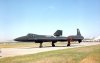
First model was actually prototyped as A-12 or YF-12 not SR71 If you look closely at the chines(where the fuselage pinches together on the sides) on the A-12 there are notches or cutouts, these were where the gun barrels would protrude from.
Guns are kinda pointless when you can travel faster than a bullet.
 

Attachments

  • 050324-F-1234P-014.jpg
    050324-F-1234P-014.jpg
    274.6 KB · Views: 20
Stinker said:
got to admit, even by todays standards that was one sick aircraft!
Like Concorde, The SR-71 was designed with sliderules and pencils. No computers.

Think about that for a second.
:D
 
God bless the boys at the Skunk Werks................:rock:

I hear they still have some secretly in action despite it's official decommissioning......:dontknow:

My favorite plane ever....of all time............:eek:

SD
 
I heard that not long after they "retired" it. They figured out that it was cheaper to fly it than to redirect, add or otherwise change the satellites to take the pics the Blackbird did, so they put it back in the air. (Albeit very thin air :D)
 
Aviation Weekly has nothing on you guys!

My wife flies and is following this thread avidly!
 
ST. LOUIS, Oct. 18, 2002 -- Boeing [NYSE: BA] today unveiled the "Bird of Prey," a technology demonstrator that pioneered breakthrough low-observable technologies and revolutionized aircraft design, development and production. The once highly classified project ran from 1992 through 1999, and was revealed because the technologies and capabilities developed have become industry standards, and it is no longer necessary to conceal the aircraft's existence.

In addition to proving many new stealth concepts, the Bird of Prey program demonstrated innovative rapid prototyping techniques. Developed by the Boeing Phantom Works advanced research-and-development organization, the Bird of Prey was among the first to initiate the use of large, single-piece composite structures; low-cost, disposable tooling; and 3-D virtual reality design and assembly processes to ensure the aircraft was affordable to build as well as high-performing.

Fully funded by Boeing, the Bird of Prey project costs $67 million. A subsonic, single-seat technology demonstrator, the aircraft completed 38 test flights as part of its flight-demonstration program. Its first flight took place in fall 1996. Bird of Prey has a wingspan of approximately 23 feet and a length of 47 feet, and weighs nearly 7,400 pounds. Powered by a Pratt & Whitney JT15D-5C turbofan engine, the Bird of Prey has an operational speed of 260 knots and a maximum operating altitude of 20,000 feet.

"Early investments in technology demonstration projects such as Bird of Prey have positioned Boeing to help shape our industry's transformation," said Jim Albaugh, president and CEO of Boeing Integrated Defense Systems. "With this aircraft, we changed the rules on how to design and build an aircraft, and what we've learned is enabling us to provide our customers with affordable, high-performing products. Projects such as Bird of Prey have provided the catalyst for integrating speed, agility and reduced cost into the processes we employ to introduce new commercial and military systems to market."

Boeing's current development of the X-45A Unmanned Combat Air Vehicle, or UCAV, technology demonstrator draws directly on its Bird of Prey experience. Some aspects of the UCAV's innovative radar-evading design, such as its shape and inlet, were developed from this project. Together, Boeing Phantom Works and Boeing Integrated Defense Systems are developing UCAV for the Defense Advanced Research Projects Agency, or DARPA, and the U.S. Air Force.

"The success of the Bird of Prey is a testament to the shared commitment of Boeing and the Air Force to pioneering innovative methods to drive down costs and improve performance," said George Muellner, senior vice president of Air Force Systems for Boeing Integrated Defense Systems. "This project stressed affordability as much as performance and quality, and is one of many that we are using to define the future of aerospace."

 
Pictures taken by the Horsted Keynes Webcam captured an unusual aircraft trail on Sunday the 14th July 2002.

They show a different formation of vapour than what you would usually expect to see from the scores of commercial and private aircraft that pass through our skies.

The picture at the top shows the contrail with lines crossing through - commonly known as donuts - spaced out along the line.

It's most likely a pulse jet engine created the donut effect propelling the aircraft up to up to Mach 6 (over 2000 mph). In this case and other similar sightings It's thought the trail could have been left by the top secret Aurora spy plane. Although the aircraft has never been officially disclosed it is thought to reside at Groom Lake USAF base commonly known as area 51.


This picture is said to be 95 percent accurate compared to the real thing when it was created following the account of an oil engineer who described the Aurora after seeing it over the North Sea.

--------------------------------------------------------------------------------
The contrail from the Horsted Keynes webcam compares to those witnessed and photographed over Scotland and Nevada in the USA. One theory is that Aurora was being flown from area 51 in the Nevada desert to an atoll in the Pacific, then on to Scotland to refuel on it's way to Iraq to gather intelligence before the last war there.


The plane's real name has been kept a secret but became known as the Aurora because a censor's slip let it appear below the SR-71 Blackbird and U-2 in the 1985 Pentagon budget request.


After our own extensive research it appears that not a lot more is known about the Aurora other than in recent years it seems it may have been put into retirement. Reliable sightings are no longer being reported and satellite technology can do the job even more discreetly and frugally.

It maybe that one day the USAF discloses the project as they did with the F-117a stealth fighter which was kept a secret for over ten years after its first pre-production test flight.

If you look at the photo below you will see a fascinating string of doughnuts traced across the sky. I took it from Princep Road in Hove, looking north just before sunset, in May 2001.
My own explanations are:
1. That it was an ordinarily plane flying through densely packed bands of wet and dry air which had been swirled together like the marbling in a cake. Flying through each wet layer left a puff of condensation.
2. An ordinarily plane was leaving a pulsating or shimmying wake of turbulence, just as a flag flaps in the wind. (Most likely).
3. The plane was dumping fuel, but I didn't think they were allowed to do that over land.
4. It really was a secret plane, but what would one of those be doing flying over Hove on a spring afternoon?
 
Above a certain altitude, and when necessary (emergencies) Aircraft are allowed to dump fuel. However, it would not produce that kind of contrail, it would look more like smoke coming from the fuel dump probe. (I've seen it!)

Interesting! I have read about the pulse engines apparently they are close to production. ?
 
i just finished working sensors on the U-2 Aircraft after 5 years. I returned from skunk works about a month ago...there are some very interesting things going on out there boys......i cant wait!!!!!
 
ntw0rk said:
They can only fuel it to 61% before takeoff because of weight, and because the skin of the aircraft is so porous on the ground the fuel would seep through.
I thought it was the seams of the SR-71 were loose and leaked when not in flight. I had heard that when it was flying at Mach 2+, the wind friction against the fuselage heated it up expanding the fuselage and sealing the seams. I think this why the pilots wore what looked like astronaut suits and the extremely high altitudes it flew at. I had also heard that they experimented with mounting guns on it once but it ended up flying into it's own rounds. I don't know these to be factual but interesting to think about.
 
You are right Silvr, that's what I meant by porous. Not sure about the bullets thing, I know they had thought about it, but I thought they scrapped the idea because it just wasn't maneuverable enough to use the guns effectively to start with. :dontknow:

And I think that there were actually mechanics involved in the "stretch". I had heard that it was designed to mechanically stretch by something like 8 feet. Sometimes those stories get "stretched" too, so it's hard to say. Suffice it to say that it did do some serious expansion in flight due to high friction as Silvr said.
 
ntw0rk said:
Not sure about the bullets thing, I know they had thought about it, but I thought they scrapped the idea because it just wasn't maneuverable enough to use the guns effectively to start with. :dontknow:


Well with the bullets they are already traveling at the same speed as the aircraft. Then once they are shot they still accelerate. I can't throw a 90 mph fast ball. But if I'm in a truck traveling 110 MPH and throw a ball forward it will still be a head of the truck. But it will be slowing down. I don't think the plane would be running into the bullets. Yes the bullets would be slowing down but they would also start to lose altitude.
 
:dito: Yeah, I think it would be virtually impossible to run into them. And even if they did, I doubt they would do any damage at all. Probably just bounce off and fall to the ground.


Next time you are at mach one in the H-3 Try it! :D
 

Latest posts

Support Us

Become A Supporting Member Today!

Click Here For Details

Back
Top