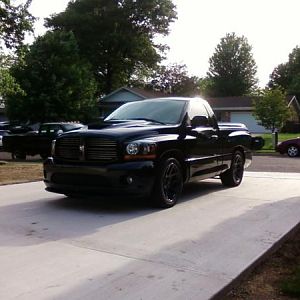
MELTED CATS!!

gblue

Full Access Member
Joined
Apr 7, 2009
Messages
82
Reaction score
0
Location
maui hawaii
Aloha...put new hi-flow cats in and after 100 miles they were both melted, Paxton says my car was running too rich, but it ran fine with the SC for 2 years....

what's up with that?

Gregg
 
melted???? Do you have any pictures?? that sounds like a real problem!
 
Don't need them anyway...

Replace them with pipe.

But get a good tuner to review your A/F...immediately.
 
Melted cats = unburned fuel introduced into the cats. It's something upstream - you're sending raw fuel into the converters.
 
Prof said:
Don't need them anyway...

Replace them with pipe....

How un-green of you.....lol:p
 
running too lean can do that as well. you definitely should install a wideband with any aftermarket power adders just to be safe(r)

Mike
 
Gregg was the melted cats the reason for the issues you told me about at the carshow? Is it possible to tell what brand of cats they were? If you decide to try some new ones make sure you purchase them from a viper expert. Roe Racing is one of them. http://roeracing.com/ProductCart/pc/viewPrd.asp?idcategory=255&idproduct=306They are not cheap though.

My truck is just too dam loud. I am over the drone. I am looking into getting some cherry bomb glasspacks installed where my cats use to be. It will be way cheaper too. One member has already done this with success.http://www.jegs.com/i/Cherry+Bomb/545/87517/10002/-1

You definatly need to find out why your engine clogged up and burned out your cats. Getting a wideband gauge is a must with FI engines too.

Let me know how it turns out.

patrick
 
cats

The cats were not the issue..the heat going into them was


...we're still checking things upsrteam. We'll put it back together without the cats and check fuel ratio and fuel pumps for the SC. Kiwi Kim is checking it out.

gregg
 
Thats what cats are supposed to handle.....heat...?? Very strange. Somebody here knows why, you just have to wait till they log on. Stinker or one of the FI guys have tackled this issue before.

patrick
 
Melted cats are usually caused by a cylinder or two misfiring. The cylinder that misfires allows unburned gas to go into the exhaust. The oxygen sensor senses this as a rich condition and commands the entire bank of injectors to lean out (not knowing that it is just one of them causing the problem). This allows extra oxygen to be introduced into the exhaust stream.

So, now you have raw fuel and extra oxygen in the exhaust with a hot catalyst. It is exactly the right formula for melt-down. It's like a blow torch going right into the cats.
 
could also be caused by running on CNG or LPG (not the case here).
Jus10 had burned cats as well probably from driving WOT with LPG.
This fuel generate 'slightly' higher EGT's.
 
WOT said:
Melted cats are usually caused by a cylinder or two misfiring. The cylinder that misfires allows unburned gas to go into the exhaust. The oxygen sensor senses this as a rich condition and commands the entire bank of injectors to lean out (not knowing that it is just one of them causing the problem). This allows extra oxygen to be introduced into the exhaust stream.

So, now you have raw fuel and extra oxygen in the exhaust with a hot catalyst. It is exactly the right formula for melt-down. It's like a blow torch going right into the cats.


Very logical post. What causes a cylinder or two to misfire?

patrick
 
cats

ok...

only 1 fuel pump was working at boost due to a melted wire..so......
that leaned out the fuel and caused the cats to melt. Fixed the wire and I'll see how it goes...no cats now....glad Hawaii has no emissions laws

tanks to all

gregg
 
Scope those pistons! Look for signs of detonation. Low fuel pressure is a fast route to lean and lean means detonation.

Pull the plugs and look for powder on the electrodes...

I would also do a leak down test immediately.

Light on fuel is potentially dangerous.

Just my opinion...
 
mauiSRT/10 said:
Very logical post. What causes a cylinder or two to misfire?

patrick

Several things can cause misfire: bad plugs, bad wires, bad coils, improper air/fuel mix, etc.

Here is something you guys might find interesting: back in college when I worked at an engine shop, we had a distributor machine that was used to calibrate ignition curves on mechanical distributors and magnetos. It would mechanically drive the distributor with an electric motor, and you could turn a knob to increase or decrease the drive speed (up to 9000 rpm or so). You also could connect all the plug wires up to a set of spark plugs that were mounted onto the machine and watch all the spark plugs fire through a clear chamber.

What was interesting was that the plugs would fire very easily at standard atmospheric pressure. But, the machine had a way to pressurize the clear chamber where the plugs resided with compressed air. At high pressures (above 150 psi or so), the plugs would start to misfire if the gap was too wide, or the coil was too weak, or if the magneto had a weak generator, etc. So with this machine, you could see and hear the plugs misfire at a given rpm. This would allow you to measure the actual rpm where your ignition system would start to misfire. On a stock system from the 70's, it would start to misfire around 4500 rpm with the equivalent of 10:1 compression.

The reason that the misfire occurs is that the energy needed to fire across the gap in the plug goes up exponentially with air pressure between the gap in the spark plug. This is why with forced induction (which raises cylinder pressure immediately prior to spark), you are more likely to have a misfire and need to narrow the plug gap accordingly.

Also, even if the plug does fire correctly, if your air/fuel ratio too far off, the flame front can get extinguished before the flame travels from the plug to the cylinder wall across the top of the piston. This allows unburned fuel and unused oxygen to be dumped into the exhaust, which then burns on it's way out of the ehaust pipe as it is mixed with other hot gases and hits the catalyst. This is why a lean mixture raises your exhaust temperature so much: it is mostly caused by incomplete combustion within the power stroke and the subsequent continuing of the burning process throughout the exhaust stroke. (This only applies to spark ignition motors, as the exact opposite is true in a diesel engine, which are stratified charge motors, a topic for another time).

 

Latest posts

Support Us

Become A Supporting Member Today!

Click Here For Details

Back
Top