
methanol and race gas

Dom426

Full Access Member
Joined
Apr 26, 2007
Messages
13,813
Reaction score
1
Location
Farmington, N.M.
do they go bad just sitting the race gas is brand new 5 galon jugs and the methanol is a five galon jug that is sealed they have been sittin for well over a yr...really dont want to take any chances runnin it in the truck just curious??

 
Yooou can check it with a hydrometer ( specific gravity) to see if it has lost any of the light end stuff.
Usually in a metal can it will keep along time , not so with plastic jugs.


That much $$$$$ invested, I would get some fresh fuel though, use the old fuel in your beater.
 
VOLUME CONVERSION

ASTM/API/IP TABLE 5A/B

ASTM/API/IP Table 5A/B gives the values of API gravities at 60° F corresponding to API gravities observed with a glass hydrometer at temperatures other than 60° F. In converting an API gravity at the observed temperature (API hydrometer indication) to the corresponding API gravity at 60° F, two corrections are necessary. The first correction is the change in volume of the glass hydrometer by temperature. The second correction is the change in volume of the oil. Both corrections have been applied to this table.

NOTE: This table must be used with API gravities (hydrometer indications) measured with a soft glass hydrometer calibrated at 60° F.


FUEL CLASSIFICATION BY API GRAVITY PROCEDURES

The first step in volume conversion is fuel classification.

Taking the Readings. Described below are the procedures that must be followed during fuel classification.
Step 1. Draw a 300-milliliter sample of fuel from the drum, nozzle, or other fuel source. Put it into a clean dry sample bottle, quart bottle with lid, or a sample can. Cover the sample container. Take the sample to a tent, building, or other sheltered place to conduct the test. Conduct the test promptly while the sample is fresh.
Step 2. Agitate the contents of the sample container by shaking it thoroughly.
Step 3. Slowly and carefully pour the sample down the inside of a clean, dry hydrometer cylinder, filling the cylinder approximately 3/4 full.
Step 4. Allow any air bubbles that are deep in the liquid to rise to the surface. Hold the cylinder just below the rim with one hand, and tap the top of the cylinder sharply with the cupped palm of the other hand to remove surface air bubbles.
Step 5. Set the cylinder on a level surface where it is protected from air currents.
Step 6. Use the hydrometer with the range closest to the API gravity range of the fuel you think you are testing. See Figure I-1. For example, if you think the fuel is diesel and the API gravity range of diesel is between 30.0 and 42.0, use the third or fourth hydrometer from the equipment list.
Step 7. Check the mercury column if the hydrometer being used has a built-in thermometer. If the mercury has separated, the hydrometer will not take acceptable temperature readings, and you should use another hydrometer. If a hydrometer with an accurate thermometer is not available, you may use a calibrated tank thermometer to measure the temperature.
Step 8. Lower the hydrometer gently into the sample.
NOTE: If the hydrometer sinks or floats with the scale out of the fuel, you have selected the wrong one for the type of fuel you are testing. Try another hydrometer close to the same range. Keep trying until a hydrometer floats in the sample.


Step 9. Stir the sample gently by raising and lowering the hydrometer, and watch the movement of the mercury in the thermometer. (A fast registering thermometer should give an accurate reading in 30 to 45 seconds.) When the mercury stops moving, take a temperature reading and record it.
Step 10. Allow the hydrometer to come to rest, but not touching the side of the cylinder. If it moves to the side, move it back to the center of the liquid and spin it gently.
Step 11. When the hydrometer is floating freely at rest, read it to the nearest scale division. Have your eye slightly below the level of the liquid, and raise it slowly until the surface of the liquid appears to be a straight line across the hydrometer scale. Record the gravity reading to the nearest scale division as shown in Figure I-2.
Step 12. Stir the sample gently again by raising and lowering the hydrometer, and take a second temperature reading. If the temperature of the fuel has not varied more than 1° F from the previous reading, record the temperature to the nearest 1° F. This is your test temperature reading. If the temperature of the sample has changed more than 1° F, repeat steps 9 through 12 until the temperature is stable (within 1° F).


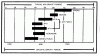
Figure I-1. Typical API gravity ranges (corrected to 60 degrees)


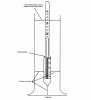
Figure I-2. Hydrometer ready to be read

Correcting Observed Reading to 60° F

Using Table 5A/B, correct the API gravity of the observed temperature to API gravity at 60° F. Table 5A is used for JP-4 and Table 5B is used for petroleum products other than JP-4. Example: Assume the observed hydrometer reading is 40.4 and the observed temperature is 83° F. The product is not JP-4. The steps are given below to correct the observed reading to 60° F.

Step 1. Find the Table 5B page that lists API gravity of 40 through 45 at observed temperature across the top and the observed temperature range of 60° through 90° F down the left side.
Step 2. Read down the left side until you find the observed temperature (83.0° F). The observed API reading of 40.4 is rounded to 40.5 (The API gravity is in increments of 0.5, so the observed API gravity must be rounded to the nearest 0.5). Read across the table to where the observed API gravity of 40.5 intersects the observed temperature of 83.0° F. The API gravity at 60° F is 38.7.
NOTE: For more precise API gravity correction to 60° F, interpolation is used. See ASTM 1250. However, when API gravity is corrected to 60° F for the purpose of volume correction using Table 6A/B, interpolation is not required.


Step 3. API gravity that is recorded on the gage worksheet for volume correction use only must be rounded off to the nearest 0.5. Round off to the nearest 0.5 as follows:
· · If the fraction is .1 or .2, round down to the nearest whole degree. (For example, 42.2 becomes 42.0.)
· · If the fraction is .3, .4, .5, .6, or .7, round to the nearest .5 degree. (For example 38.3 becomes 38.5, or 38.7 becomes 38.5.)
· · If the fraction is .8 or .9, round up to the nearest whole number. (For example, 42.8 becomes 43.0.)
Classifying the Fuel

The fuel is now classified. The steps are described below:

Step 1. Compare the corrected API gravity with the API gravity ranges shown in Figure I-1. If the corrected API gravity of the product is lower or higher than expected, it indicates possible commingling with either heavier or lighter products.
Step 2. If the corrected API gravity is NOT within range for the fuel you are testing, isolate and mark the fuel container; sample the fuel; and send the sample to your supporting laboratory for identification, complete analysis, and disposition instructions. Do not use the fuel until you receive disposition instructions from the laboratory.
ASTM/API/IP TABLE 6A/B

ASTM/API/IP Table 6A/B gives you the facts you need to convert product volumes observed at temperatures other than 60° F for values of API gravity in the range of 0° to 100° API. The volume correction factor in these tables makes no allowance for the thermal expansion of tanks and other containers. You must use these tables with API gravity values at 60° F and values measured at Fahrenheit temperatures. Table 6A is used for JP-4 and table 6B is used for all petroleum products other than JP-4 See DA PAM 710-2-1. For example, what is the volume of 63,162 gallons of diesel at 83° F? The product’s API gravity at 60° F is 38.5. Use the Table 6B column "API gravity at 60° F," headed 38.5° API, and note that against an "Observed Temperature" of 83° F the factor is .9890. Therefore, 1 US gallon of product having a gravity of 38.5° API at 60° F and measured at 83° F occupies at 60° F a volume of .9890. Thus, 63,162 US gallons measured at 83° F occupy a volume of 63,162 X. 9890 (or 62,467) US gallons at 60° F.

The specific gravity of some common liquids and fluids can be found in the table below:

http://www.engineeringtoolbox.com/specific-gravity-liquids-d_336.html

Fluid Temperature(oC) Specific Gravity(oC)

Acetic Acid 25 1.052
Acetone 25 0.787
Acetylene, liquid -121oF 0.62
Acetylene, liquid 70oF 0.38
Adipic acid 0.72
Alcohol, ethyl (ethanol) 25 0.787
Alcohol, methyl (methanol) 25 0.791
Alcohol, propyl 25 0.802
Ammonia (aqua) 25 0.826
Aniline 25 1.022
Benzene 25 0.876
Benzil 25 1.084
Bromine 25 3.12
Butane, liquid 25 0.601
Caproic acid 25 0.924
Carbolic acid 15 0.959
Carbon disulfide 25 1.265
Carbon tetrachloride 25 1.589
Carene 25 0.860
Oil, Castor 25 0.959
Chloride 25 1.56
Chloroform 25 1.469
Citric acid 25 1.665
Coconut Oil 15 0.927
Cotton Seed Oil 15 0.929
Cresol 25 1.027
Creosote 15 1.070
Crude oil, California 60oF 0.918
Crude oil, Mexican 60oF 0.976
Crude oil, Texas 60oF 0.876
Cumene 25 0.862
Decane 25 0.728
Dodecane 25 0.757
Ethane -89 0.572
Ether 25 0.716
Ethylamine 16 0.683
Ethylene glycol 25 1.100
Fluorine (freon) refrigerant R-11 25 1.480
Fluorine refrigerant R-12 25 1.315
Fluorine refrigerant R-22 25 1.197
Formaldehyde 45 0.815
Fuel oil 60oF 0.893
Furan 25 1.421
Furforal 25 1.159
Gasoline, natural 60oF 0.713
Gasoline, Vehicle 60oF 0.739
Glycerin 25 1.263
Glycerol 25 1.129
Heptane 25 0.681
Hexane 25 0.657
Hexanol 25 0.813
Hexene 25 0.673
Hydrazine 25 0.797
Kerosene 60oF 0.820
Linolenic Acid 25 0.902
Linseed Oil 25 0.932
Mercury 25 13.633
Methane -164 0.466
Milk 1.035
Naphtha, Petroleum Naphtha 15 0.667
Wood 25 0.701
Napthalene 25 0.963
Nonanol 25 0.823
Octane 25 0.701
Olive Oil 15 0.703
Oxygen -183 1.14
Palmitic Acid 25 0.853
Pentane 25 0.755
Phenol 25 1.075
Phosgene 0 1.381
Phytadiene 25 0.826
Pinene 25 0.858
Propane -40 0.585
Propane 25 0.495
Propylene 25 0.516
Propylene glycol 25 1.036
Pyridine 25 0.968
Parole 25 0.969
Resorcinol 25 1.272
Sabiname 25 0.814
Sea water 25 1.028
Silane 25 0.719
Sorbaldehyde 25 0.898
Stearic Acid 25 0.941
Styrene 25 0.906
Terpinene 25 0.850
Toluene 25 0.865
Turpentine 25 0.871
Water, pure 39.2oF (4oC) 1.000
Water, sea 77oF 1.025


YOu Owe Me A Lobster Dinner:p ;)
 

Attachments

  • Image537.gif
    Image537.gif
    264.4 KB · Views: 508
  • Image760.gif
    Image760.gif
    33.5 KB · Views: 1,202
Last edited:
Understanding Specific Gravity
By:Dave Harris


--------------------------------------------------------------------------------

Specific gravity is the ratio of the mass of a liquid to the mass of an equal volume of distilled water at 64° F which is represented by 1.000 Specific Gravity on a fuel chart. Most fuel suppliers can offer the specific gravity number of a fuel. Should the fuel not match the specifications supplied, it might be contaminated fuel which could cause poor performance.

Specific gravity MUST always be referenced to a particular temperature reading. The specific gravity of a liquid decreases with a rise in temperature or increases when its temperature is lowered. Testing the specific gravity of a liquid will not identify its contents. it is only the measure of the weight of the fuel vs. distilled water. Methanol is commonly contaminated by water – which is heavier than the fuel. Checking the specific gravity allows the purity of the fuel to be referenced. When contaminated with a lighter or heavier specific gravity element, the final specific gravity reading will be lighter or heavier than the originally tested weight depending on the contamination of the fuel and the temperature reading.


WHY CHECK THE FUEL?

Combustion engines perform best at only one air-fuel ratio, and the ratio is determined by the weight of the air/fuel mixture. Since all carburetors and fuel injection systems meter fuel by volume, a jetting change must be made if the specific gravity of the fuel changes for any reason. This change will adjust the volume to keep the weight of the fuel going to the engine consistent. For instance, if the specific gravity of the fuel increases by 4%, then the volume of fuel put through the carb/injector system must be decreased by 4% to keep the net weight going into the engine consistent.

Many racing facilities and sanctioning bodies use the VP/Kinsler Fuel Analyzer Kit (sold by any VP distributor) to ensure the legality/accuracy of the fuel per any fuel rules the body might have. Alternative methods are available, but they can be cost prohibitive and time consuming.


OCTANE

Octane is a unit of measurement used to rate a fuels ability to resist detonation. Detonation (spark knock or “ping) is the tendency of the fuel to explode violently in the engine rather than burn smoothly at the precise moment when combustion occurs in the cylinder of the motor. If the fuel detonates, the pressure in the combustion chamber rises so fast and high that it is like beating on the top of the piston with a hammer – this is the primary cause of piston, rod, and bearing failures. The higher the octane rating, the higher the resistance of the fuel to detonate. Racing fuel is blended to provide additional octane rating, not necessarily more energy. In fact, all grades of fuel have about the same amount of energy per pound. Increasing the octane can help produce more power since more compression or spark advance is necessary to achieve the optimum performance level with that fuel. Too much octane, however, can slow the burn rate of the fuel causing a loss of power.


FUEL COMPARISONS

There is a big difference in specific gravity between various brands and grades of fuel, often even between two batches of the same brand. The typical range of premium automotive pump gas is .730 - .760 specific gravity rating. Aviation fuel is .680 - .720. Some unleaded racing fuel is as heavy as .790. Many blends of pump gas can often contain as much as 10% ethanol – measuring in a much heavier specific gravity range.


For Example:

Unocal 76 Unleaded Racing Fuel - .788 Specific Gravity @ 59° F.

Unocal 76 Leaded Racing Fuel - .728 Specific Gravity @ 59° F.


METHANOL (ALCOHOL)

The specific gravity of pure methanol is .792 @ 68° F. Methanol, methyl alcohol or wood alcohol (CH3OH), is usually made from natural gas. It was first discovered in 1823 by the method of condensing hot gases from the burning of wood. It has been the fuel for Indy Cars since 1965. Methanol has the ability to absorb water, even right of the atmosphere. Keeping your fuel sealed will help prevent contamination. Adding water to alcohol will increase the specific gravity reading of the fuel. High levels of water contamination will cause the alcohol to get a cloudy haze in it. Loss of engine performance will typically occur before the contamination reaches these levels. Fuel should be checked with a hydrometer before using the fuel, possibly as you get you fuel from your supplier, just to avoid any problems. Methanol is extremely corrosive to aluminum and magnesium, so, great care should be taken to keep this reaction to a minimum. The fuel system components should be constructed of materials that do not react with methanol (stainless steel, brass, etc) or they should have a protective coating. Methanol also crystallizes when it dries and this dried material does not readily dissolve. The fuel system will need constant attention in this instance. When the methanol-burning vehicle is not in use, the fuel should be drained from the fuel system. Flushing or “picklingâ€￾ with regular gasoline is a common practice to flush the system.


ETHANOL

The specific gravity of ethanol is .815 @ 68° F. Ethanol, ethyl alcohol or grain alcohol (CH3CH2OH), is a liquid derived from corn or other grain, other agricultural products or agricultural waste. Because ethanol is corrosive (due to oxidation), the same preventative maintenance as methanol must be utilized to protect the fuel system components.

In the 1880’s, Henry Ford built one of his first automobiles – the Quadricycle – and it was fueled with ethanol. Early Ford Model T’s had a carburetor adjustment that could allow the vehicle to run ethanol fuel that was produced by local farmers. Ford’s vision was reportedly to build a vehicle that was affordable to the working family and powered by a fuel that would boost the rural form economy. However, in the past, due to various reasons, any alternative fuels other than standard gasoline were suppressed. Today, we are seeing the return of alternative fuel vehicles.


NITROMETHANE

The specific gravity of pure nitromethane – nicknamed “nitroâ€￾ is 1.139 @ 60-70° F and is chemically CH3NO2. The specific gravity of pure alcohol is .792 @ 68° F is obviously quite different from nitro. It is simple to determine the percentage of nitro in alcohol by measuring the specific gravity of the mixture. Adding nitro to alcohol will increase its specific gravity. A chart can be set up to show the percentage of nitro vs. specific gravity (as supplied with the fuel testing kit available from VP Racing.)

The procedure is only slightly complicated by the fact that temperature affects the specific gravity, since any fluid expands as it is warmed, and therefore has a lower specific gravity when warming occurs. For example, a 60% mixture of nitro and alcohol heated, we know that the mixture is still 60%, yet the specific gravity is decreased when this happens.

Some brands of nitro hydrometer kits are sold without a temperature correction table. Errors of up to 5% can be common if not temperature correction is used. For best engine performance, the nitro percent mixture should be kept within one or two percent of what the engine was specifically tuned for.

NOTE: Mixing nitromethane fuel with alcohol creates a mild endothermic reaction which absorbs heat from the mixture, thus, cooling the mixture (opposite of most reactions, which usually give off heat). The maximum affect is with about 50% mixture, which cools approximately 15° F.


DETERMINING JETTING CHANGES FOR DIFFERENT SPECIFIC GRAVITY READINGS

Since the specific gravity of a liquid decreases with a rise in temperature, specific gravity must always be referenced to a particular temperature. The accepted standard is 60° F.

However, since it is not always convenient to measure a liquid at 60° F in the field, a chart has been compiled to allow the specific gravity to be measured at any temperature, and then corrected to a 60° F reading. The chart is included when you purchase a fuel testing kit from VP Racing.

Example: at 90° F, the specific gravity reading of standard gasoline is .747. However, to compare it to the specific gravity reading at 60° F, the chart will indicate the number is .760. This is how you can read the chart to make sure your fuel readings are as accurate as possible.


Procedure for adjusting jetting from one type or batch of fuel to a new batch:

Measure the specific gravity of the “previous/oldâ€￾ fuel and note the jetting size that performed best with that fuel.
Measure the specific gravity of the new batch of fuel.
Calculate the percent difference between the previous fuel and the new fuel:
If the new fuel checked at .712 and the previous fuel at .736, the difference is -3.26%.
Jetting correction for the new fuel
Calculate the area of the old main jet and increase or decrease them by the same percentage found in the results above. Larger jets are richer than smaller ones.
<!--[if !supportLists]--> i. <!--[endif]--> [Old jet area = (old jet area x % from step 3 above] = new jet area required to obtain the same performance with the new fuel.

<!--[if !supportLists]--> ii. <!--[endif]--> Sign (+ or -) is the opposite of the sign found for the % in Step 3 above.


PROCEDURE FOR OBTAINING SPECIFIC GRAVITY READINGS

<!--[if !supportLists]--> 1. <!--[endif]--> Hold the glass cylinder almost horizontal; place the hydrometer and thermometer into the glass. Slowly bring the cylinder to an upright position while jiggling both meters to allow them to fall to the bottom.

<!--[if !supportLists]--> 2. <!--[endif]--> Fill the glass cylinder to within an inch of the top of the fuel sample. This will cause the hydrometer to project out of the top of the glass for easy positioning with your fingers.

<!--[if !supportLists]--> 3. <!--[endif]--> Place the glass in a shady area. Wait a few minutes for the temperature to stabilize.

<!--[if !supportLists]--> 4. <!--[endif]--> Carefully sight across the bottom of the meniscus and read the hydrometer. The hydrometer muse be floating freely when you read it – not in contact with the glass cylinder or your fingers.

<!--[if !supportLists]--> 5. <!--[endif]--> Hold the thermometer up so that the bulb on the end is at about the middle of the part of the hydrometer that is submerged in the test fuel. Read the temperature.

<!--[if !supportLists]--> 6. <!--[endif]--> Note that you now have observed the specific gravity of the test fuel. To find the true specific gravity of the fuel, you must use the temperature correction chart supplied with the fuel test kit. Go down the column that has the heading temperature that is closest to the one you observed until you come to the specific gravity you observed, and then read across the 60° F column on the chart to calculate the “trueâ€￾ specific gravity of the fuel you are testing
 
http://www.ktm950.info/how/gasoline/spec_gravity.html

Understanding Specific Gravity
By:Dave Harris


--------------------------------------------------------------------------------
Many racing facilities and sanctioning bodies use the VP/Kinsler Fuel Analyzer Kit (sold by any VP distributor) to ensure the legality/accuracy of the fuel per any fuel rules the body might have. Alternative methods are available, but they can be cost prohibitive and time consuming.


Specific gravity is the ratio of the mass of a liquid to the mass of an equal volume of distilled water at 64° F which is represented by 1.000 Specific Gravity on a fuel chart. Most fuel suppliers can offer the specific gravity number of a fuel. Should the fuel not match the specifications supplied, it might be contaminated fuel which could cause poor performance.

Specific gravity MUST always be referenced to a particular temperature reading. The specific gravity of a liquid decreases with a rise in temperature or increases when its temperature is lowered. Testing the specific gravity of a liquid will not identify its contents. it is only the measure of the weight of the fuel vs. distilled water. Methanol is commonly contaminated by water – which is heavier than the fuel. Checking the specific gravity allows the purity of the fuel to be referenced. When contaminated with a lighter or heavier specific gravity element, the final specific gravity reading will be lighter or heavier than the originally tested weight depending on the contamination of the fuel and the temperature reading.


WHY CHECK THE FUEL?

Combustion engines perform best at only one air-fuel ratio, and the ratio is determined by the weight of the air/fuel mixture. Since all carburetors and fuel injection systems meter fuel by volume, a jetting change must be made if the specific gravity of the fuel changes for any reason. This change will adjust the volume to keep the weight of the fuel going to the engine consistent. For instance, if the specific gravity of the fuel increases by 4%, then the volume of fuel put through the carb/injector system must be decreased by 4% to keep the net weight going into the engine consistent.

Many racing facilities and sanctioning bodies use the VP/Kinsler Fuel Analyzer Kit (sold by any VP distributor) to ensure the legality/accuracy of the fuel per any fuel rules the body might have. Alternative methods are available, but they can be cost prohibitive and time consuming.


OCTANE

Octane is a unit of measurement used to rate a fuels ability to resist detonation. Detonation (spark knock or “ping) is the tendency of the fuel to explode violently in the engine rather than burn smoothly at the precise moment when combustion occurs in the cylinder of the motor. If the fuel detonates, the pressure in the combustion chamber rises so fast and high that it is like beating on the top of the piston with a hammer – this is the primary cause of piston, rod, and bearing failures. The higher the octane rating, the higher the resistance of the fuel to detonate. Racing fuel is blended to provide additional octane rating, not necessarily more energy. In fact, all grades of fuel have about the same amount of energy per pound. Increasing the octane can help produce more power since more compression or spark advance is necessary to achieve the optimum performance level with that fuel. Too much octane, however, can slow the burn rate of the fuel causing a loss of power.


FUEL COMPARISONS

There is a big difference in specific gravity between various brands and grades of fuel, often even between two batches of the same brand. The typical range of premium automotive pump gas is .730 - .760 specific gravity rating. Aviation fuel is .680 - .720. Some unleaded racing fuel is as heavy as .790. Many blends of pump gas can often contain as much as 10% ethanol – measuring in a much heavier specific gravity range.


For Example:

Unocal 76 Unleaded Racing Fuel - .788 Specific Gravity @ 59° F.

Unocal 76 Leaded Racing Fuel - .728 Specific Gravity @ 59° F.


METHANOL (ALCOHOL)

The specific gravity of pure methanol is .792 @ 68° F. Methanol, methyl alcohol or wood alcohol (CH3OH), is usually made from natural gas. It was first discovered in 1823 by the method of condensing hot gases from the burning of wood. It has been the fuel for Indy Cars since 1965. Methanol has the ability to absorb water, even right of the atmosphere. Keeping your fuel sealed will help prevent contamination. Adding water to alcohol will increase the specific gravity reading of the fuel. High levels of water contamination will cause the alcohol to get a cloudy haze in it. Loss of engine performance will typically occur before the contamination reaches these levels. Fuel should be checked with a hydrometer before using the fuel, possibly as you get you fuel from your supplier, just to avoid any problems. Methanol is extremely corrosive to aluminum and magnesium, so, great care should be taken to keep this reaction to a minimum. The fuel system components should be constructed of materials that do not react with methanol (stainless steel, brass, etc) or they should have a protective coating. Methanol also crystallizes when it dries and this dried material does not readily dissolve. The fuel system will need constant attention in this instance. When the methanol-burning vehicle is not in use, the fuel should be drained from the fuel system. Flushing or “pickling” with regular gasoline is a common practice to flush the system.


ETHANOL

The specific gravity of ethanol is .815 @ 68° F. Ethanol, ethyl alcohol or grain alcohol (CH3CH2OH), is a liquid derived from corn or other grain, other agricultural products or agricultural waste. Because ethanol is corrosive (due to oxidation), the same preventative maintenance as methanol must be utilized to protect the fuel system components.

In the 1880’s, Henry Ford built one of his first automobiles – the Quadricycle – and it was fueled with ethanol. Early Ford Model T’s had a carburetor adjustment that could allow the vehicle to run ethanol fuel that was produced by local farmers. Ford’s vision was reportedly to build a vehicle that was affordable to the working family and powered by a fuel that would boost the rural form economy. However, in the past, due to various reasons, any alternative fuels other than standard gasoline were suppressed. Today, we are seeing the return of alternative fuel vehicles.


NITROMETHANE

The specific gravity of pure nitromethane – nicknamed “nitro” is 1.139 @ 60-70° F and is chemically CH3NO2. The specific gravity of pure alcohol is .792 @ 68° F is obviously quite different from nitro. It is simple to determine the percentage of nitro in alcohol by measuring the specific gravity of the mixture. Adding nitro to alcohol will increase its specific gravity. A chart can be set up to show the percentage of nitro vs. specific gravity (as supplied with the fuel testing kit available from VP Racing.)

The procedure is only slightly complicated by the fact that temperature affects the specific gravity, since any fluid expands as it is warmed, and therefore has a lower specific gravity when warming occurs. For example, a 60% mixture of nitro and alcohol heated, we know that the mixture is still 60%, yet the specific gravity is decreased when this happens.

Some brands of nitro hydrometer kits are sold without a temperature correction table. Errors of up to 5% can be common if not temperature correction is used. For best engine performance, the nitro percent mixture should be kept within one or two percent of what the engine was specifically tuned for.

NOTE: Mixing nitromethane fuel with alcohol creates a mild endothermic reaction which absorbs heat from the mixture, thus, cooling the mixture (opposite of most reactions, which usually give off heat). The maximum affect is with about 50% mixture, which cools approximately 15° F.


DETERMINING JETTING CHANGES FOR DIFFERENT SPECIFIC GRAVITY READINGS

Since the specific gravity of a liquid decreases with a rise in temperature, specific gravity must always be referenced to a particular temperature. The accepted standard is 60° F.

However, since it is not always convenient to measure a liquid at 60° F in the field, a chart has been compiled to allow the specific gravity to be measured at any temperature, and then corrected to a 60° F reading. The chart is included when you purchase a fuel testing kit from VP Racing.

Example: at 90° F, the specific gravity reading of standard gasoline is .747. However, to compare it to the specific gravity reading at 60° F, the chart will indicate the number is .760. This is how you can read the chart to make sure your fuel readings are as accurate as possible.


Procedure for adjusting jetting from one type or batch of fuel to a new batch:

Measure the specific gravity of the “previous/old” fuel and note the jetting size that performed best with that fuel.
Measure the specific gravity of the new batch of fuel.
Calculate the percent difference between the previous fuel and the new fuel:
If the new fuel checked at .712 and the previous fuel at .736, the difference is -3.26%.
Jetting correction for the new fuel
Calculate the area of the old main jet and increase or decrease them by the same percentage found in the results above. Larger jets are richer than smaller ones.
<!--[if !supportLists]--> i. <!--[endif]--> [Old jet area = (old jet area x % from step 3 above] = new jet area required to obtain the same performance with the new fuel.

<!--[if !supportLists]--> ii. <!--[endif]--> Sign (+ or -) is the opposite of the sign found for the % in Step 3 above.


PROCEDURE FOR OBTAINING SPECIFIC GRAVITY READINGS

<!--[if !supportLists]--> 1. <!--[endif]--> Hold the glass cylinder almost horizontal; place the hydrometer and thermometer into the glass. Slowly bring the cylinder to an upright position while jiggling both meters to allow them to fall to the bottom.

<!--[if !supportLists]--> 2. <!--[endif]--> Fill the glass cylinder to within an inch of the top of the fuel sample. This will cause the hydrometer to project out of the top of the glass for easy positioning with your fingers.

<!--[if !supportLists]--> 3. <!--[endif]--> Place the glass in a shady area. Wait a few minutes for the temperature to stabilize.

<!--[if !supportLists]--> 4. <!--[endif]--> Carefully sight across the bottom of the meniscus and read the hydrometer. The hydrometer muse be floating freely when you read it – not in contact with the glass cylinder or your fingers.

<!--[if !supportLists]--> 5. <!--[endif]--> Hold the thermometer up so that the bulb on the end is at about the middle of the part of the hydrometer that is submerged in the test fuel. Read the temperature.

<!--[if !supportLists]--> 6. <!--[endif]--> Note that you now have observed the specific gravity of the test fuel. To find the true specific gravity of the fuel, you must use the temperature correction chart supplied with the fuel test kit. Go down the column that has the heading temperature that is closest to the one you observed until you come to the specific gravity you observed, and then read across the 60° F column on the chart to calculate the “true” specific gravity of the fuel you are testing
 
Last edited:
505'sFastestViper. said:
do you have this in spanish !!!!hahahaha
VOLUMEN DE CONVERSIÓN

ASTM / API / IP CUADRO 5A / B

ASTM / API / IP Tabla 5A / B indica los valores de las gravedades API a 60 ° F correspondiente a las gravedades API observado con un hidrómetro de vidrio a temperaturas diferentes a 60 ° F. En la conversión de una gravedad API en la temperatura observada (indicación del hidrómetro API) correspondientes a la gravedad API a 60 ° F, dos correcciones son necesarias. El primer ejercicio es el cambio en el volumen del hidrómetro de vidrio por la temperatura. La segunda corrección es el cambio de volumen del aceite. Ambas correcciones se han aplicado a esta tabla.

NOTA: Esta tabla se debe utilizar con gravedades API (indicaciones hidrómetro) mide con un hidrómetro de vidrio suave calibrados a 60 ° F.


CLASIFICACION POR PROCEDIMIENTOS DE COMBUSTIBLE GRAVEDAD API

El primer paso en la conversión de volumen es la clasificación de combustible.

Tomando las lecturas. A continuación se describen los procedimientos que deben seguirse durante la clasificación de combustible.
Paso 1. Extraer una muestra de 300 mililitros de combustible del tambor, la boquilla, o la fuente de combustible. Se mete en una botella para muestras limpio y seco, cuarto de botella con tapa, o muestra una lata. Cubra el recipiente con la muestra. Tomar la muestra de una tienda de campaña, la construcción, o cualquier otro lugar protegido para llevar a cabo la prueba. Realice la prueba con prontitud, mientras que la muestra es fresca.
Paso 2. Agitar el contenido del recipiente de la muestra por agitación a fondo.
Paso 3. Poco a poco y con cuidado vierta la muestra por el interior de un cilindro limpio, seco hidrómetro, llenando el cilindro aproximadamente 3 / 4 llena.
Paso 4. Permita que las burbujas de aire que son profundas en el líquido a subir a la superficie. Sostenga la botella justo debajo del borde con una mano y toque en la parte superior del cilindro fuertemente con la palma de la mano de la otra mano para eliminar las burbujas de aire en la superficie.
Paso 5. Coloque el cilindro sobre una superficie plana donde se está protegido de las corrientes de aire.
Paso 6. El uso más cercana el hidrómetro con la gama de la gama de gravedad API del combustible que usted cree que está probando. Véase el gráfico I-1. Por ejemplo, si usted piensa que el combustible es diesel y el rango de gravedad API del gasóleo se sitúa entre 30,0 y 42,0, utiliza el hidrómetro tercero o cuarto de la lista de equipo.
Paso 7. Compruebe la columna de mercurio si el hidrómetro se utiliza tiene un termómetro incorporado. Si el mercurio se ha separado, el hidrómetro no tomar lecturas de temperatura aceptable, y tiene que utilizar otro hidrómetro. Si un hidrómetro con un termómetro exacto no está disponible, puede usar un termómetro del tanque calibrado para medir la temperatura.
Paso 8. Bajo el hidrómetro suavemente en la muestra.
NOTA: Si se hunde o flota hidrómetro a cabo con la escala de este combustible, que ha seleccionado el incorrecto para el tipo de combustible que se está probando. Pruebe con otro hidrómetro cerca de la misma gama. Sigue intentándolo hasta que un hidrómetro flota en la muestra.


Paso 9. Agitar la muestra suavemente subiendo y bajando el hidrómetro, y observar el movimiento del mercurio en el termómetro. (Un rápido registro de termómetro debe dar una lectura exacta en 30 a 45 segundos.) Cuando el mercurio deja de moverse, tomar la temperatura y grabarlo.
Paso 10. Deje que el hidrómetro para venir a descansar, pero sin tocar el lado del cilindro. Si se mueve hacia un lado, se mueven de nuevo al centro del líquido y girar suavemente.
Paso 11. Cuando el hidrómetro está flotando libremente en reposo, lo leyó a la división de escala más próxima. Haga que su ojo ligeramente por debajo del nivel del líquido, y aumentar lentamente hasta que la superficie del líquido que parece ser una línea recta a través de la escala del hidrómetro. Registro de la gravedad de lectura a la división de escala más próxima, como se muestra en la Figura I-2.
Paso 12. Agitar la muestra suavemente de nuevo por subir y bajar el hidrómetro, y tomar una segunda lectura de la temperatura. Si la temperatura del combustible no ha variado más de 1 ° F de la lectura anterior, registra la temperatura con una precisión de 1 ° F. Esta es su lectura de la temperatura de prueba. Si la temperatura de la muestra ha cambiado más de 1 ° F, repita los pasos del 9 al 12 hasta que la temperatura se mantiene estable (dentro de 1 ° F).


Figura I-1. Los rangos de densidad API (corregida a 60 grados)


Figura I-2. Hidrómetro listo para ser leído

La corrección de la lectura observada a 60 ° F

Usando la Tabla 5A / B, corrija la gravedad API de la temperatura observada a la gravedad API a 60 ° F. Cuadro 5A se utiliza para el JP-4 y 5B tabla se utiliza para productos petrolíferos distintos de JP-4. Ejemplo: Supongamos que la indicación del hidrómetro se observa es 40,4 y la temperatura observada es de 83 ° F. El producto no es JP-4. Los pasos se dan a continuación para corregir la lectura observada a 60 ° F.

Paso 1. Busca la página que muestra el cuadro 5B gravedad API de 40 a 45 a la temperatura observada en la parte superior y el rango de temperatura observada de 60 ° a 90 ° F en el lado izquierdo.
Paso 2. Leer en el lado izquierdo hasta que encuentre la temperatura observada (83,0 ° F). El observó la lectura de la API de 40,4 se redondea a 40,5 (La gravedad API es en incrementos de 0,5, por lo que la observada gravedad API debe ser redondeado a 0,5). Lea sobre la mesa para que lo observado gravedad API de 40,5 corta a la temperatura observada de 83,0 ° C. La gravedad API a 60 ° F es 38,7.
NOTA: Para más precisa corrección de la gravedad API a 60 ° F, la interpolación se utiliza. Ver ASTM 1250. Sin embargo, cuando la gravedad API es corregida a 60 ° F con el fin de corregir el volumen medio de la tabla 6A / B, la interpolación no es necesario.


Paso 3. API de gravedad que se registra en la hoja de calibre para el uso del volumen de corrección sólo debe ser redondeado al más próximo de 0,5. Termine con una aproximación de 0,5 de la siguiente manera:
· · Si la fracción es 0.1 o 0.2, redondear a la baja al grado más próximo conjunto. (Por ejemplo, el 42,2 se convierte en 42,0.)
· · Si la fracción es 0.3, 0.4, 0.5, 0.6, o 0.7, redondo, con precisión de 0,5 grados. (Por ejemplo, 38,3 se convierte en 38,5 o 38,7 se convierte en 38,5.)
· · Si la fracción es 0.8 o 0.9, redondee al número entero más próximo. (Por ejemplo, el 42,8 se convierte en 43,0.)
La clasificación de los combustibles

El combustible se clasificarán. Los pasos se describen a continuación:

Paso 1. Comparar la gravedad API corregida a la gravedad API rangos mostrados en la Figura I-1. Si la gravedad API corregida del producto es inferior o superior a lo esperado, indica posible la mezcla con cualquiera de los productos más pesados o más ligeros.
Paso 2. Si la gravedad API corregida no es dentro del rango para el combustible que está probando, aislar y marcar el recipiente de combustible; muestras del combustible, y enviar la muestra a su apoyo de laboratorio para la identificación, análisis completo, y las instrucciones de la disposición. No utilice el combustible hasta que reciba instrucciones de la disposición del laboratorio.
ASTM / API / IP CUADRO 6A / B

ASTM / API / IP cuadro 6A / B le da la información que necesita para convertir los volúmenes de producto observado a otras temperaturas de 60 ° F para los valores de gravedad API en el rango de 0 ° a 100 ° API. El factor de corrección del volumen en estas tablas no tiene en cuenta la expansión térmica de los tanques y otros recipientes. Debe utilizar estas tablas con valores de gravedad API a 60 ° F y los valores medidos a una temperatura Fahrenheit. Cuadro 6A se utiliza para JP-4 y en el cuadro 6B se utiliza para todos los productos petrolíferos distintos de JP-4 Véase DA PAM 710-2-1. Por ejemplo, ¿cuál es el volumen de 63.162 galones de diesel a 83 ° F? La gravedad API del producto a 60 ° F es de 38,5. Utilice el cuadro 6B columna "gravedad API a 60 ° F," encabezada 38,5 ° API, y tenga en cuenta que contra una temperatura "observados" de 83 ° F es el factor de 0.9890. Por lo tanto, 1 galón EE.UU. de productos que tengan una densidad de 38,5 ° API a 60 ° F y se mide a los 83 ° F ocupa a 60 ° F un volumen de 0.9890. Así, 63.162 galones EE.UU. medido a 83 ° F ocupan un volumen de 63.162 X. 9890 (o 62.467) galones EE.UU. a 60 ° F.

El peso específico de algunos líquidos comunes y los líquidos se pueden encontrar en el siguiente cuadro:

http://www.engineeringtoolbox.com/sp...ids-d_336.html

Temperatura del fluido (° C) Gravedad específica (oC)

Ã￾cido acético 25 1,052
Acetona 25 0,787
Acetileno, líquido-121oF 0,62
Acetileno, líquido 70oF 0,38
Ã￾cido adípico 0,72
El alcohol, etílico (etanol) 25 0,787
El alcohol, metílico (metanol) 25 0,791
El alcohol, propilo 25 0,802
El amoníaco (aqua) 25 0,826
Anilina 25 1,022
Benceno 25 0,876
Bencilo 25 1,084
El bromo 25 3,12
Butano, líquido 25 0,601
Ã￾cido caproico 25 0,924
Con ácido carbólico 15 0,959
Disulfuro de carbono 25 1,265
Tetracloruro de carbono 25 1,589
Carène 25 0,860
El petróleo, Castor 25 0.959
Cloruro de 25 1,56
Cloroformo 25 1,469
Ã￾cido cítrico 25 1,665
El aceite de coco 15 0,927
Aceite de semilla de algodón 15 0,929
Cresol 25 1,027
La creosota 15 1,070
El petróleo crudo, California 60oF 0,918
El petróleo crudo, México 60oF 0,976
El petróleo crudo, Texas 60oF 0,876
Cumeno 25 0,862
Decane 25 0,728
Dodecano 25 0,757
Etano 0.572 -89
Éter 25 0,716
Etilamina 16 0,683
Etilenglicol 25 1,100
Flúor (freón) refrigerante R-11 25 1,480
El flúor refrigerante R-12 25 1,315
El flúor refrigerante R-22 25 1,197
El formaldehído 45 0,815
Fuel 60oF 0,893
Furanos 25 1,421
Furforal 25 1,159
La gasolina, naturales 60oF 0,713
La gasolina, vehículos 60oF 0,739
Glicerina 25 1,263
Glicerol 25 1,129
Heptano 25 0,681
Hexano 25 0,657
Hexanol 25 0,813
Hexeno 25 0,673
Hidracina 25 0.797
Kerosene 60oF 0,820
Ã￾cido linoleico 25 0,902
El aceite de linaza 25 0,932
Mercurio 25 13.633
El metano -164 0.466
Leche 1,035
Nafta, nafta de petróleo 15 0,667
Madera 25 0,701
Naftaleno 25 0,963
Nonol 25 0,823
Octano 25 0,701
Aceite de Oliva 15 0,703
Oxígeno -183 1.14
El ácido palmítico 25 0,853
Pentano 25 0,755
Fenol 25 1,075
El fosgeno 0 1.381
Phytadiene 25 0,826
Pinene 25 0,858
Propano 0.585 -40
Propano 25 0,495
Propileno 25 0,516
Propilenglicol 25 1,036
Piridina 25 0,968
Parole 25 0,969
Resorcinol 25 1,272
Sabiname 25 0,814
Agua de mar 25 1,028
Silano 25 0,719
Sorbaldehyde 25 0,898
Ã￾cido esteárico 25 0,941
Estireno 25 0,906
Terpineno 25 0,850
Tolueno 25 0,865
Trementina 25 0,871
Agua, 39.2oF pura (4 ° C) 1,000
El agua, el mar 77oF 1,025


Me debes una cena de langosta
Contribute a better translation
Thank you for contributing your translation suggestion to Google Translate.
Contribute a better translation:
VOLUMEN DE CONVERSIÓN <br> <br>ASTM / API / IP CUADRO 5A / B <br> <br>ASTM / API / IP Tabla 5A / B indica los valores de las gravedades API a 60 ° F correspondiente a las gravedades API observado con un hidrómetro de vidrio a temperaturas diferentes a 60 ° F. En la conversión de una gravedad API en la temperatura observada (indicación del hidrómetro API) correspondientes a la gravedad API a 60 ° F, dos correcciones son necesarias. El primer ejercicio es el cambio en el volumen del hidrómetro de vidrio por la temperatura. La segunda corrección es el cambio de volumen del aceite. Ambas correcciones se han aplicado a esta tabla. <br> <br>NOTA: Esta tabla se debe utilizar con gravedades API (indicaciones hidrómetro) mide con un hidrómetro de vidrio suave calibrados a 60 ° F. <br> <br> <br>CLASIFICACION POR PROCEDIMIENTOS DE COMBUSTIBLE GRAVEDAD API <br> <br>El primer paso en la conversión de volumen es la clasificación de combustible. <br> <br>Tomando las lecturas. A continuación se describen los procedimientos que deben seguirse durante la clasificación de combustible. <br>Paso 1. Extraer una muestra de 300 mililitros de combustible del tambor, la boquilla, o la fuente de combustible. Se mete en una botella para muestras limpio y seco, cuarto de botella con tapa, o muestra una lata. Cubra el recipiente con la muestra. Tomar la muestra de una tienda de campaña, la construcción, o cualquier otro lugar protegido para llevar a cabo la prueba. Realice la prueba con prontitud, mientras que la muestra es fresca. <br>Paso 2. Agitar el contenido del recipiente de la muestra por agitación a fondo. <br>Paso 3. Poco a poco y con cuidado vierta la muestra por el interior de un cilindro limpio, seco hidrómetro, llenando el cilindro aproximadamente 3 / 4 llena. <br>Paso 4. Permita que las burbujas de aire que son profundas en el líquido a subir a la superficie. Sostenga la botella justo debajo del borde con una mano y toque en la parte superior del cilindro fuertemente con la palma de la mano de la otra mano para eliminar las burbujas de aire en la superficie. <br>Paso 5. Coloque el cilindro sobre una superficie plana donde se está protegido de las corrientes de aire. <br>Paso 6. El uso más cercana el hidrómetro con la gama de la gama de gravedad API del combustible que usted cree que está probando. Véase el gráfico I-1. Por ejemplo, si usted piensa que el combustible es diesel y el rango de gravedad API del gasóleo se sitúa entre 30,0 y 42,0, utiliza el hidrómetro tercero o cuarto de la lista de equipo. <br>Paso 7. Compruebe la columna de mercurio si el hidrómetro se utiliza tiene un termómetro incorporado. Si el mercurio se ha separado, el hidrómetro no tomar lecturas de temperatura aceptable, y tiene que utilizar otro hidrómetro. Si un hidrómetro con un termómetro exacto no está disponible, puede usar un termómetro del tanque calibrado para medir la temperatura. <br>Paso 8. Bajo el hidrómetro suavemente en la muestra. <br>NOTA: Si se hunde o flota hidrómetro a cabo con la escala de este combustible, que ha seleccionado el incorrecto para el tipo de combustible que se está probando. Pruebe con otro hidrómetro cerca de la misma gama. Sigue intentándolo hasta que un hidrómetro flota en la muestra. <br> <br> <br>Paso 9. Agitar la muestra suavemente subiendo y bajando el hidrómetro, y observar el movimiento del mercurio en el termómetro. (Un rápido registro de termómetro debe dar una lectura exacta en 30 a 45 segundos.) Cuando el mercurio deja de moverse, tomar la temperatura y grabarlo. <br>Paso 10. Deje que el hidrómetro para venir a descansar, pero sin tocar el lado del cilindro. Si se mueve hacia un lado, se mueven de nuevo al centro del líquido y girar suavemente. <br>Paso 11. Cuando el hidrómetro está flotando libremente en reposo, lo leyó a la división de escala más próxima. Haga que su ojo ligeramente por debajo del nivel del líquido, y aumentar lentamente hasta que la superficie del líquido que parece ser una línea recta a través de la escala del hidrómetro. Registro de la gravedad de lectura a la división de escala más próxima, como se muestra en la Figura I-2. <br>Paso 12. Agitar la muestra suavemente de nuevo por subir y bajar el hidrómetro, y tomar una segunda lectura de la temperatura. Si la temperatura del combustible no ha variado más de 1 ° F de la lectura anterior, registra la temperatura con una precisión de 1 ° F. Esta es su lectura de la temperatura de prueba. Si la temperatura de la muestra ha cambiado más de 1 ° F, repita los pasos del 9 al 12 hasta que la temperatura se mantiene estable (dentro de 1 ° F). <br> <br> <br>Figura I-1. Los rangos de densidad API (corregida a 60 grados) <br> <br> <br> <br>Figura I-2. Hidrómetro listo para ser leído <br> <br>La corrección de la lectura observada a 60 ° F <br> <br>Usando la Tabla 5A / B, corrija la gravedad API de la temperatura observada a la gravedad API a 60 ° F. Cuadro 5A se utiliza para el JP-4 y 5B tabla se utiliza para productos petrolíferos distintos de JP-4. Ejemplo: Supongamos que la indicación del hidrómetro se observa es 40,4 y la temperatura observada es de 83 ° F. El producto no es JP-4. Los pasos se dan a continuación para corregir la lectura observada a 60 ° F. <br> <br>Paso 1. Busca la página que muestra el cuadro 5B gravedad API de 40 a 45 a la temperatura observada en la parte superior y el rango de temperatura observada de 60 ° a 90 ° F en el lado izquierdo. <br>Paso 2. Leer en el lado izquierdo hasta que encuentre la temperatura observada (83,0 ° F). El observó la lectura de la API de 40,4 se redondea a 40,5 (La gravedad API es en incrementos de 0,5, por lo que la observada gravedad API debe ser redondeado a 0,5). Lea sobre la mesa para que lo observado gravedad API de 40,5 corta a la temperatura observada de 83,0 ° C. La gravedad API a 60 ° F es 38,7. <br>NOTA: Para más precisa corrección de la gravedad API a 60 ° F, la interpolación se utiliza. Ver ASTM 1250. Sin embargo, cuando la gravedad API es corregida a 60 ° F con el fin de corregir el volumen medio de la tabla 6A / B, la interpolación no es necesario. <br> <br> <br>Paso 3. API de gravedad que se registra en la hoja de calibre para el uso del volumen de corrección sólo debe ser redondeado al más próximo de 0,5. Termine con una aproximación de 0,5 de la siguiente manera: <br>· · Si la fracción es 0.1 o 0.2, redondear a la baja al grado más próximo conjunto. (Por ejemplo, el 42,2 se convierte en 42,0.) <br>· · Si la fracción es 0.3, 0.4, 0.5, 0.6, o 0.7, redondo, con precisión de 0,5 grados. (Por ejemplo, 38,3 se convierte en 38,5 o 38,7 se convierte en 38,5.) <br>· · Si la fracción es 0.8 o 0.9, redondee al número entero más próximo. (Por ejemplo, el 42,8 se convierte en 43,0.) <br>La clasificación de los combustibles <br> <br>El combustible se clasificarán. Los pasos se describen a continuación: <br> <br>Paso 1. Comparar la gravedad API corregida a la gravedad API rangos mostrados en la Figura I-1. Si la gravedad API corregida del producto es inferior o superior a lo esperado, indica posible la mezcla con cualquiera de los productos más pesados o más ligeros. <br>Paso 2. Si la gravedad API corregida no es dentro del rango para el combustible que está probando, aislar y marcar el recipiente de combustible; muestras del combustible, y enviar la muestra a su apoyo de laboratorio para la identificación, análisis completo, y las instrucciones de la disposición. No utilice el combustible hasta que reciba instrucciones de la disposición del laboratorio. <br>ASTM / API / IP CUADRO 6A / B <br> <br>ASTM / API / IP cuadro 6A / B le da la información que necesita para convertir los volúmenes de producto observado a otras temperaturas de 60 ° F para los valores de gravedad API en el rango de 0 ° a 100 ° API. El factor de corrección del volumen en estas tablas no tiene en cuenta la expansión térmica de los tanques y otros recipientes. Debe utilizar estas tablas con valores de gravedad API a 60 ° F y los valores medidos a una temperatura Fahrenheit. Cuadro 6A se utiliza para JP-4 y en el cuadro 6B se utiliza para todos los productos petrolíferos distintos de JP-4 Véase DA PAM 710-2-1. Por ejemplo, ¿cuál es el volumen de 63.162 galones de diesel a 83 ° F? La gravedad API del producto a 60 ° F es de 38,5. Utilice el cuadro 6B columna &quot;gravedad API a 60 ° F,&quot; encabezada 38,5 ° API, y tenga en cuenta que contra una temperatura &quot;observados&quot; de 83 ° F es el factor de 0.9890. Por lo tanto, 1 galón EE.UU. de productos que tengan una densidad de 38,5 ° API a 60 ° F y se mide a los 83 ° F ocupa a 60 ° F un volumen de 0.9890. Así, 63.162 galones EE.UU. medido a 83 ° F ocupan un volumen de 63.162 X. 9890 (o 62.467) galones EE.UU. a 60 ° F. <br> <br>El peso específico de algunos líquidos comunes y los líquidos se pueden encontrar en el siguiente cuadro: <br> <br>http://www.engineeringtoolbox.com/sp...ids-d_336.html <br> <br>Temperatura del fluido (° C) Gravedad específica (oC) <br> <br>Ã￾cido acético 25 1,052 <br>Acetona 25 0,787 <br>Acetileno, líquido-121oF 0,62 <br>Acetileno, líquido 70oF 0,38 <br>Ã￾cido adípico 0,72 <br>El alcohol, etílico (etanol) 25 0,787 <br>El alcohol, metílico (metanol) 25 0,791 <br>El alcohol, propilo 25 0,802 <br>El amoníaco (aqua) 25 0,826 <br>Anilina 25 1,022 <br>Benceno 25 0,876 <br>Bencilo 25 1,084 <br>El bromo 25 3,12 <br>Butano, líquido 25 0,601 <br>Ã￾cido caproico 25 0,924 <br>Con ácido carbólico 15 0,959 <br>Disulfuro de carbono 25 1,265 <br>Tetracloruro de carbono 25 1,589 <br>Carène 25 0,860 <br>El petróleo, Castor 25 0.959 <br>Cloruro de 25 1,56 <br>Cloroformo 25 1,469 <br>Ã￾cido cítrico 25 1,665 <br>El aceite de coco 15 0,927 <br>Aceite de semilla de algodón 15 0,929 <br>Cresol 25 1,027 <br>La creosota 15 1,070 <br>El petróleo crudo, California 60oF 0,918 <br>El petróleo crudo, México 60oF 0,976 <br>El petróleo crudo, Texas 60oF 0,876 <br>Cumeno 25 0,862 <br>Decane 25 0,728 <br>Dodecano 25 0,757 <br>Etano 0.572 -89 <br>Éter 25 0,716 <br>Etilamina 16 0,683 <br>Etilenglicol 25 1,100 <br>Flúor (freón) refrigerante R-11 25 1,480 <br>El flúor refrigerante R-12 25 1,315 <br>El flúor refrigerante R-22 25 1,197 <br>El formaldehído 45 0,815 <br>Fuel 60oF 0,893 <br>Furanos 25 1,421 <br>Furforal 25 1,159 <br>La gasolina, naturales 60oF 0,713 <br>La gasolina, vehículos 60oF 0,739 <br>Glicerina 25 1,263 <br>Glicerol 25 1,129 <br>Heptano 25 0,681 <br>Hexano 25 0,657 <br>Hexanol 25 0,813 <br>Hexeno 25 0,673 <br>Hidracina 25 0.797 <br>Kerosene 60oF 0,820 <br>Ã￾cido linoleico 25 0,902 <br>El aceite de linaza 25 0,932 <br>Mercurio 25 13.633 <br>El metano -164 0.466 <br>Leche 1,035 <br>Nafta, nafta de petróleo 15 0,667 <br>Madera 25 0,701 <br>Naftaleno 25 0,963 <br>Nonol 25 0,823 <br>Octano 25 0,701 <br>Aceite de Oliva 15 0,703 <br>Oxígeno -183 1.14 <br>El ácido palmítico 25 0,853 <br>Pentano 25 0,755 <br>Fenol 25 1,075 <br>El fosgeno 0 1.381 <br>Phytadiene 25 0,826 <br>Pinene 25 0,858 <br>Propano 0.585 -40 <br>Propano 25 0,495 <br>Propileno 25 0,516 <br>Propilenglicol 25 1,036 <br>Piridina 25 0,968 <br>Parole 25 0,969 <br>Resorcinol 25 1,272 <br>Sabiname 25 0,814 <br>Agua de mar 25 1,028 <br>Silano 25 0,719 <br>Sorbaldehyde 25 0,898 <br>Ã￾cido esteárico 25 0,941 <br>Estireno 25 0,906 <br>Terpineno 25 0,850 <br>Tolueno 25 0,865 <br>Trementina 25 0,871 <br>Agua, 39.2oF pura (4 ° C) 1,000 <br>El agua, el mar 77oF 1,025 <br> <br> <br>Me debes una cena de langosta

Now, this is part one, translated courtesy of the Taco Bell Chihuaha - I cannot guarantee it's accuracy, if not sure - you may want to "ask a mexican" - LOL !!! ;) ;) ;)
 
505'sFastestViper. said:
do they go bad just sitting the race gas is brand new 5 galon jugs and the methanol is a five galon jug that is sealed they have been sittin for well over a yr...really dont want to take any chances runnin it in the truck just curious??

Throw it away it is junk...........

Had to dispose of 54 gallons of C16 recently.
 
FSTJACK said:
Throw it away it is junk...........

Had to dispose of 54 gallons of C16 recently.

Ouch. That had to hurt. :eek:


I usually drain and refill my water/meth tank in the spring. I believe some of the methanol evaporates out over the winter but I don't know exactly how much. So I just drain and refill it fresh in the spring.:rock:
 
ViperTruck2933 said:
Ouch. That had to hurt. :eek:


I usually drain and refill my water/meth tank in the spring. I believe some of the methanol evaporates out over the winter but I don't know exactly how much. So I just drain and refill it fresh in the spring.:rock:
It did, but the gas had decomposed and was junk......:mad::mad::mad:


I would not let the meth go for more than 90 days as it will also degrade.............
 

Latest posts

Support Us

Become A Supporting Member Today!

Click Here For Details

Back
Top