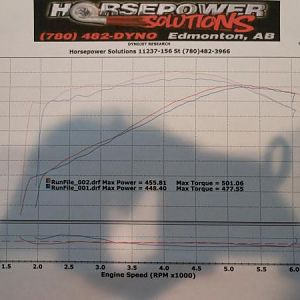


Built Motor with Paxton Results

Texas Yellow Fever said:
Maybe I'm missing the whole point here, but why would you essentially go backwards by introducing inefficiency. Isn't the whole reason we spend all these $$$ on engines etc to get the most air through them possible all the while making the most HP possible? The better answer is step up and fill the void that has been created...:burnout:

You may have missed the first sentence of my original post.:dontknow:..... "Yup, more boost (with a higher capacity turbo or a s/c would do the trick) and that is correct, the fact there is less "back pressure" indicates throughput assuming everything is working as it should"..

Tony's analogy with the big pipe/small pipe is true.

Velocity produces torque and smaller passages produce velocity (torque) up to the point where they become a restriction and the potential for increased horsepower falls. Horsepower is ONLY torque measured over time....right?...

And by doing what I suggested, you aren't really introducing inefficiency. There is already too much volume in the intake system for his Paxton (coupled with an early pressure drop with the performance cam). With a manifold swap and valve lash change, you are just encouraging the production of some usable power, that's all.

Complex subject ...

Happy Holidays!

Rotten
 
Last edited:

Stinker said:
even with that tiny, and I could be wrong, but I dont think they will make the power a turbo set up will:)

Yes, however, I am expecting the Procharger to make more power earlier, and make more power under the curve. The punch when mashing the throttle should be nearly instantaneous too.;)

But just in case, I might not want to be so anxious to sell that 500 shot system.:D

BTW (for whomever asked), I'm running a stock length stroke and 9:1 CR, and had a net of 618 flywheel HP without the Paxton through a stock intake manifold, ECU, and fuel system. Compare that to a peak rear wheel HP of about 648 at 4psi of boost with the sheet metal intake, custom ECU, and balls-out fuel system. At 12-14psi, we should see a slight improvement.

I believe this all comes down to matching the compressor (whatever it may be) to the engine's volumetric efficiency. The Roe and Paxton are doing fine on engines that are otherwise close to stock, but peak out around 700-ish. As soon as you reduce the compression ratio AND increase the flow on the top of the engine, you increase the engine's forced induction potential significantly. However, it has become quite obvious that to achieve that potential it has to be matched up with a compressor that can exploit those properties. That's what it's going to take to hit four figures of HP w/o nitrous.;)

Simply put, think about what the difference is in CFM rather than boost pressure. A deep breathing engine at 4psi is moving lots more air than a relatively stock engine at that same pressure.
 
QuickSilver said:
:D ... and this would be that motor. Maybe a 200/shoot out of the whole, and a 350/shoot to finish...:D

321723.jpg


For my Tuck that dcperformance set-up:
Now I see why Dan didn't even want to put headers on her...she needs some back pressure.
For a streeter she's just fine for me. You don't meet-up with to many guy's running 650/rwhp on the street. Besides she's fun in traffic :argh: :mad: :D :burnout:

Quick
Fu$&in eh!!!!:rock: :rock: :rock: :rock:
thewelshm
 
As in bamboo shoot?

Or maybe did Cheney actually shoot the lawyer?

;) :D :D

After all, I am...
 
Ram From Hell said:
Yes, however, I am expecting the Procharger to make more power earlier, and make more power under the curve. The punch when mashing the throttle should be nearly instantaneous too.;)

But just in case, I might not want to be so anxious to sell that 500 shot system.:D

BTW (for whomever asked), I'm running a stock length stroke and 9:1 CR, and had a net of 618 flywheel HP without the Paxton through a stock intake manifold, ECU, and fuel system. Compare that to a peak rear wheel HP of about 648 at 4psi of boost with the sheet metal intake, custom ECU, and balls-out fuel system. At 12-14psi, we should see a slight improvement.

I believe this all comes down to matching the compressor (whatever it may be) to the engine's volumetric efficiency. The Roe and Paxton are doing fine on engines that are otherwise close to stock, but peak out around 700-ish. As soon as you reduce the compression ratio AND increase the flow on the top of the engine, you increase the engine's forced induction potential significantly. However, it has become quite obvious that to achieve that potential it has to be matched up with a compressor that can exploit those properties. That's what it's going to take to hit four figures of HP w/o nitrous.;)

Simply put, think about what the difference is in CFM rather than boost pressure. A deep breathing engine at 4psi is moving lots more air than a relatively stock engine at that same pressure.


but ya'lls is gonna make some serious hp:burnout: :burnout:

I say......................1100 to the ground:rock:
 
tinygiants said:
Fixed it for you.

I think JMB, Fstjack, and RamFromHell will prove that statement. The new ProCharger they are using will likely make as much power as Doms build does on Turbo.
i would not bet on that dale:D
 
Stinker said:
LOLOl Dom these guys are never gonna catch up bro:p

I can hear jack and eric now...............:argh: :argh: :argh: :argh: :argh:
hey what do you think about my gear selection? bonneville anyone:D :D :D :D
 
505'sFastestViper. said:
i would not bet on that dale:D
Your current build, not the new bigger build :)

How are you guys going to deal with block twist? I see that Scrambler plans on a midplate on his motor. I know that Jack has a plate on his race truck. But with these ridiculous numbers soon to be put down by you guys won't block flex become an issue?
 
tinygiants said:
Your current build, not the new bigger build :)

How are you guys going to deal with block twist? I see that Scrambler plans on a midplate on his motor. I know that Jack has a plate on his race truck. But with these ridiculous numbers soon to be put down by you guys won't block flex become an issue?
it has a torque limiter on it fabbed by justin
 
I have been reading the thread but I havent seen what pully you are using on the paxton. if you are using the stock one of course you are going to make small lbs. I had one made and made 12lbs of boost. I would get a smaller pully before I said it cant flow. also the boost numbers are on ported heads and a custom cam.
 
avmech said:
I have been reading the thread but I havent seen what pully you are using on the paxton. if you are using the stock one of course you are going to make small lbs. I had one made and made 12lbs of boost. I would get a smaller pully before I said it cant flow. also the boost numbers are on ported heads and a custom cam.
thats already been done
 
505'sFastestViper. said:
thats already been done


I musta missed that

but,on my ,ahem,Ford Lightning:eek: ,

When I went to long tube headers ,extrude honed upper intake,catless,and single blade throttle body
I HAD to use bigger lower pulley and even looked at a smaller blower pulley to increase boost to compensate for the better airflow
 
HOT RAM said:
I musta missed that

but,on my ,ahem,Ford Lightning:eek: ,

When I went to long tube headers ,extrude honed upper intake,catless,and single blade throttle body
I HAD to use bigger lower pulley and even looked at a smaller blower pulley to increase boost to compensate for the better airflow

Exactly, b/c the rest of the combo flowed so well, you probably lost boost just running the stock pulley combination. That's also why a lot of L owners run more efficient blowers like a Kenne Bell or Whipple.

But we're talking 331 cubes vs. 505 cubes, not to mention a different blower altogether.

I'm surprised that a high-end Paxton NOVI, Vortech YS-trim, etc couldn't flow enough air, though. I know guys with 427 cube Fords and 427 LS-motor'd GM motors running these blowers and making well over 800rwhp. Granted, these motors pull a little more rpm, and the peak HP is higher up in the rev-range, but still airflow is airflow, no matter the size of the engine.

I don't know what cam is in there, but with a centrifugally blown application, it needs very little overlap. Lots of overlap will kill it and not allow it to build much boost at lower, mid-range rpms.
 
Last edited:

Latest posts

Support Us

Become A Supporting Member Today!

Click Here For Details

Back
Top