Camshaft choosing "how to"

camshaft duration

Here's the intake cycle from start to finish. The duration (in this example 270 degrees) is indicated by arrow three. The degrees opening before TDC is indicated by arrow one, and the degrees after BDC to the closing point by arrow two. Number four indicates the intake centerline angle, which is exactly halfway between the opening and closing point.
 

Attachments

  • 0607phr_02_z+camshaft_basics+intake_duration_diagram.jpg
    0607phr_02_z+camshaft_basics+intake_duration_diagram.jpg
    70.4 KB · Views: 32
Another One

This is a simplified version of how it all works .....but on a double overhead cam engine.
Valve overlap isn't really shown, but neither is a plug wire or an oil pickup, or an injector.
Can we sue someone?...just a thought...
 

Attachments

  • 4-Stroke-Engine.gif
    4-Stroke-Engine.gif
    403.8 KB · Views: 26
Last edited:
Stinker said:
camshaft duration

Here's the intake cycle from start to finish. The duration (in this example 270 degrees) is indicated by arrow three. The degrees opening before TDC is indicated by arrow one, and the degrees after BDC to the closing point by arrow two. Number four indicates the intake centerline angle, which is exactly halfway between the opening and closing point.

I'm confused....(really):hmmmm2:
 
Lets cut this apart step by step, and maybe this will help some

its a 270 cam, aobut the same as the mopar cam for the v-10


Description: Hydraulic Roller-Slight noticeable idle, will work with stock computer, excellent torque throughout range.
Cam Family:
Specifications
Intake Exhaust
RPM-Range: 1000-6200

Valve Timing: .006
Duration:
Lobe-Center Angle:114
intake center line 114
duration intake 269 exhaust 274
Duration @ .050" Lift: intake 218 exhaust 224
Valve Lift: intake .528 exhaust .536
Lobe Lift: intake .33 exhasut .335
Installation Notes

Valve Timing @ 0.006" Lift: Open /Close
Intake 21 degrees BTDC 68 DEGREES ABDC


Exhuast 72 DEGREES BBDC 24 DEGREES ATDC
 
rottenronnie said:
"Oh, Oh... I KNOW, I KNOW" !!!

"Because, during overlap (when both the intake and exhaust valves are open), blower pressure goes right out the exhaust port at low(er) engine speeds. This condition is made worse with more overlap (and more duration).


(Did I pass?).....:)

On a blown engine don't you want a bit more overlap. Because you are pressurizing the cylinder you can have more overlap to blow down or scavenge the cylinder for a cleaner charge.

Now this would mean less boost as per the CFM discharge of the blower but it also mean a cleaner intake charge and a more efficient one............

Now the question is the benifits of a cleaner charge lost to the the drop in psi/squeeze?
 
Stinker said:
Lets cut this apart step by step, and maybe this will help some

its a 270 cam, aobut the same as the mopar cam for the v-10


Description: Hydraulic Roller-Slight noticeable idle, will work with stock computer, excellent torque throughout range.
Cam Family:
Specifications
Intake Exhaust
RPM-Range: 1000-6200

Valve Timing: .006
Duration:
Lobe-Center Angle:114
intake center line 114
duration intake 269 exhaust 274
Duration @ .050" Lift: intake 218 exhaust 224
Valve Lift: intake .528 exhaust .536
Lobe Lift: intake .33 exhasut .335
Installation Notes

Valve Timing @ 0.006" Lift: Open /Close
Intake 21 degrees BTDC 68 DEGREES ABDC


Exhuast 72 DEGREES BBDC 24 DEGREES ATDC


Ok now put up the stock camshaft numbers
 
ooohhhk

so which one are you reccomending for my engine and why Stink?

Speed


Stinker said:
Figured we needed a thread to discuss the differences between camshafts, especially with some of the greatest knowledgable people we have on this forum:rock:

below is some definitions to get us started:boring:

but.......you can discuss what cam would be good for N/A, turbos, or superchargers,
and yes there is a venom edition camshaft comming out for the supercharged paxtons, Eddies will be the first to try it:rock:


LIFT: The cam's basic function is to open the valves. Lift refers to how far the valve is opened (or lifted) off its seat. A street performance cam will usually have between .450- and .550-inch lift. More lift can increase power, and increased lift without changing duration increases power without affecting the point of peak power on the rpm band. The rocker arms have a direct effect on lift because they don't have a 1:1 lever ratio. A cam that has .318 inch of lobe lift (that's how far it lifts the lifter) will open the valve .477 inch with 1.5:1 rocker arms (.318 x 1.5 = .477) and .508 inch with 1.6:1 rockers.

Generally, a stock engine will tolerate .500-inch lift before the valves hit the pistons or the valvesprings hit coil bind, but any time lift is increased, these clearances should be checked.


DURATION: Duration is how long the cam holds the valves open. It's expressed in degrees of crankshaft rotation (remember, the cam rotates at half the speed of the crank). A 280-degree-duration cam holds the valves open longer than a 260-degree-duration cam. Holding the valves open longer allows more air and fuel into the engine and also allows more to get out through the exhaust. Longer duration (higher number) improves top-end power but almost always sacrifices low-end torque. Lower duration improves low-end torque and makes the car idle better, but it limits top-end power, and you can get only so much valve lift with a short duration cam due to the rate-of-lift limitations of the lifter. Roller cams, which we'll discuss below, have the advantage of allowing high rates of lift with relatively short duration.

The confusing thing about duration is the difference between "advertised" and "at .050-lift" duration. At .050-lift duration is measured from the point where the cam moves the lifter up .050 inch until .050 inch before the lifter is all the way back down. Most cam manufacturers differ in where they start and finish measuring for advertised duration. Some start at .004-inch lift, some at .008-inch and some measure it somewhere in between. That's why the .050-lift numbers are the best to go by. A 280 cam (advertised duration) from one manufacturer could actually have less at-.050 duration than a 278 cam from another, due to the different points at which the companies measure advertised duration.

LOBE SEPARATION ANGLE: This is the relationship between the centerlines of the intake and exhaust lobes. A 110-degree lobe separation angle means that the peak opening points of the intake and exhaust lobes are 110 degrees apart. This is ground into the cam and can't be changed without changing cams. Lobe separation angle is another way of expressing overlap, which is the term formerly used by cam manufacturers. Overlap is the amount of time that both valves are open in the same cylinder. When both valves are open at the same time, cylinder pressure drops. A cam with 106 degrees of lobe separation angle will have more overlap and a rougher idle than one with 112 degrees, but it'll usually make more midrange power.


This illustration shows what we mean by lobe separation angle: the angle between the intake and exhaust lobes. Notice that the lobe ramps overlap a bit. While the exhaust valve is closing, the intake is already opening. That's overlap. The narrower this angle (the lower the number), the more time both valves are open in the cylinder and therefore the more overlap

 
bigike said:
On a blown engine don't you want a bit more overlap. Because you are pressurizing the cylinder you can have more overlap to blow down or scavenge the cylinder for a cleaner charge.

Now this would mean less boost as per the CFM discharge of the blower but it also mean a cleaner intake charge and a more efficient one............

Now the question is the benifits of a cleaner charge lost to the the drop in psi/squeeze?

bigike-

I see what you mean.

My thought would be any excess overlap (depending on the amount of boost here) and some, maybe too much of the new charge, would be forced out the exhaust while that valve is also open. Remember, the whole intake tract is under pressure so an exit, like an open exhaust valve, would be a quick escape for everything.
 
Last edited:
rottenronnie said:
pokeyT-

A project was in the works, using a custom roller (among other things), in a build for yellow venom as he is going Roe.
I wanted to kill some cylinder pressure down low, in an attempt to carry the engine through the detonation-danger area when it is under massive grunt (low vehicle speed at wide open throttle); esp, with the automatic trans and even more weight, in the Quad Cabs.

In my humble opinion, I still think the original roes hit too hard, too soon, in the heavy trucks.

Unfortunately, the project had to be shelved.


I am still interested in doing to cam swap out Ron,I gotta have it done to go to Sacremento May 9th!:rock: :burnout:
 
some simple explinations
Longer duration
more peak power, rougher idle,
higher fuel consumption,
higher emissions,
less torque at low RPMs,
power peak occurs at higher RPM,
power rpm band widens and moves up

Shorter duration the opposite of the above results

Tighter lobe centers
more peak power,
higher fuel consumption
rougher idle
more torque at low RPMS,
peak power occurs at LOWER RPM,
higher emissions,
power RPM band gets narrower and moves DOWN

Wider lobe centers opposite of above

Advancing the cam
slightly improved low rpm torque,
slightly reduced peak power
imperceptible change in emissions, idle & fuel consumption

Retarding the cam opposite of the above
 
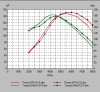
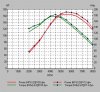
This graph shows the effects of cam duration on HP and torque for two hypothetical cams, one a 258 degree cam @ 108 lobe center angle, 0 degrees advance, and the other 278 degree cam @ 108 lobe center angle, 0 degrees of advance
 

Attachments

  • duration_Graph.jpg
    duration_Graph.jpg
    71.4 KB · Views: 39
This graph shows the effects on HP and torque of advancing the cam timing by +5 and -5 degrees. The cam has a duration of 278 degrees, and 108 lobe center.
 

Attachments

  • Advance_graph  5 degrees.jpg
    Advance_graph 5 degrees.jpg
    67.4 KB · Views: 25
Last edited:
This graph compares the effects of lobe center angle on HP and torque. The two cams are both S2 with 278 degrees duration and 0 advance, but one has 103 degrees lobe center angle, and the other has 113 degrees lobe center angle
 

Attachments

  • Centers_Graph.jpg
    Centers_Graph.jpg
    65.4 KB · Views: 24
Last edited:
Thanks Rotten and Stink!

So with an increased R/S ratio (ie 1.75:1 instead of 1.57:1) the same duration cam would have more time to "breathe". Wouldn't you also adjust the intake center line to match the new peak velocity of the piston? Can you tell that I have increased mine.:D :p :D
 
Stinker said:
sooo, why does the duration of the cam have an affect on where peak trq is?

and in simple terms what is duration?:marchmellow:

More guessing here
Duration effects:
Shorter Durations - Has less time for A/F to move into the cylinder but increases the effective compression ratio on that A/F charge. Thus increasing TQ down low in the RPM band. Since less time is available at higher RPM's for cylinder filling peak HP is decreased.
Longer Durations - Exact opposite.
 
rottenronnie said:
Check POST #20, this thread...:)

Downloaded camquest. It looks like a stripped down version of DynoSim. I have dynosim but have never been able to figure out the intake manifold to use to match the Viper's. Have all of the flow sheets for stock, ported, and Striker street heads. Intake makes over a 200HP difference so selecting the right one makes a huge difference.
 

Latest posts

Support Us

Become A Supporting Member Today!

Click Here For Details

Back
Top