electronic question

SNAKEGUTS said:
You can adjust the brightness of a led with a voltage regulator.

You can get variable voltage regulators thru many part catalogs.

MEC, Digi Key, just search for voltage regulator kits on the net.

Also want to make sure kit will work within the proper voltage range 12-16volts.

Also water prof the regulator, and dont cover the heat sink.

Good luck sir.


One other thing.

The led system you are workin with prob. has a driver before the leds.

It may not be able to be regulated. You may half to bypass this but you could risk burning up your leds.

In this case you will need the regulator and then proper resistors for the leds.

Could be a real pain.:D
 
Stinker said:
got some leds in sorta a brake light, but want to tone the power of the lights down so they are not so bright..

any suggestions electronic wizards?

Go to Radio shack get 150k, 100K, 50K, 25K and a 10k see what you like. Make sure they are high watt of better yet flameproof. 1 or 2 watts would be good.
 
Less current : less light
LEDs are current driven devices. Fewer amps in means fewer photons out. But we don’t generally power LEDs from a true current source. The vast majority of power supplies are voltage sources, and that’s what we usually find powering LEDs.

The relationship between current and voltage in an LED is non-linear. As the voltage increases from zero there is only a trickle of current and no noticeable light. At about a volt and a half (we’re talking red LEDs here) the current begins to increase appreciably and the first glimmers appear. At two volts the LED is bright and with a fraction more it’s very bright. Once over about 2.2 volts, the current rapidly soars beyond safe operation. The LED soon overheats and dies.

Nonetheless, you can power an LED directly from a voltage source if you control the voltage carefully, but there are problems. As the temperature of the LED changes the operating voltage for constant light output changes. Generally we would prefer that the light levels stay put. Further, if you parallel a number of LEDs and power them directly from a voltage source, they won’t all have the same light output. Each will have a slightly different operating voltage for the same light output. All in all, powering LEDs directly from a voltage source is not such a good idea.

So make it act linear
The usual approach is to put a resistor in series with the LED. The combination is still non-linear, but in a much more well behaved manner. In fact, over the range of safe operating current, it acts incrementally linear.

The catch is that it wastes power. If a 12 volt supply is powering a single LED-resistor combination, 2 volts goes to the LED and 10 to the resistor. Only one sixth of the power makes it to the LED.

If you only have a few LEDs this is not a big deal. If you’re lighting several panels you may have a couple hundred LEDs. Depending upon your budget and power supplies, this may become a big deal.

There are several approaches with varying degrees of complexity that address this. An effective compromise between complexity and efficiency is to place several LEDs in series with a single resistor. If four LEDs are placed in series, two thirds of the power makes it to the LEDs, quite an improvement.

If you simply reduce the voltage to a resistor-LED series combination, you will dim the LED. The slight hiccup is that the LEDs will not begin to light up until there’s about 1.5 volts across each LED. If you have four LEDs in series, the power supply has to be cranked up to 6 volts to get those red photons started.

So if you’ve got a 0 to 12 volt variable power supply dimming your 4-LED chain, you have to turn the knob half way around before you get some action. A subtle point, to be sure, but an important one to the true dimming aficionado.

Here’s an inexpensive dimmer that starts at about 5.6 volts and goes up to 2 volts below the supply voltage. It uses readily available parts and can supply up to an amp of lighting current if the 7805 has an adequate heat sink. You could have up to about 50 groups of four LEDs, although the 7805 may start to get a bit toasty.

Not all LEDs have the same forward voltage drop. The 2.0~2.2 volts common for red LEDs is not shared by all LEDs. Blue and white LEDs may have up to 5 volts across them when operating normally, although 3.5 volts is more common. If you want to use this dimmer circuit with 3.5 volt blue or white LEDs, put just two LEDs in series and use 150 ohm resistors in place of the 82 ohm units.

 
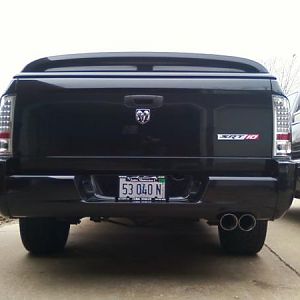
it was actually for Griff, he bought a viper third light for his truck , but when lite it is so bright it overtakes most everything else, and he is looking for a way to tone them down a bit,

the VHT was one optionn, but Mark is having a fit trying to get the right look with it.
 
Get a handful of 75-300 ohm resistors, and put one in at a time till you get the brightness you want. Some will not light at all and some will not make much difference.
 
Stinker said:
got some leds in sorta a brake light, but want to tone the power of the lights down so they are not so bright..

any suggestions electronic wizards?
Need to change the value of the resistor/ resistors depending on how your brake light was built. You could also just add one before the light to change the brightness also. The resistor value will vary depending on amount of leds and specs of the leds used. The third brake light i built was actually hurting peoples eyes when i applied the brake so i had to make a few changes to mine :).
 
Stinker said:
got some leds in sorta a brake light, but want to tone the power of the lights down so they are not so bright..

any suggestions electronic wizards?

Dude, I've got a friend who really knows LED's on vehicles. I'll ask him and see what he knows.
 
OK a buddy of mine is fooling around with LED's as well. He showed me how the resistors work. The light I have has about 18 led I think. If I hook one resistor up will it drop the whole panel of leds?


JeffBoyette thanks for the input. From what you said it sounds like I am on the right track ....No?
 
A potentiometer gets my vote. That way during the day you can make it brighter, and at night tone it down a bit. . . .
 
I used window tint on mine. It gave it a smoked look too.
 
Ok, I also have the viper coupe thrid brake light in my tailgate. However it is not hooked up yet.

I also have a extra viper brake light.

I took a minute and wired up the extra one I have, and damm they are bright!

Yes you can dim the whole panel of leds.

I powered mine with a 12volt battery and then a 9volt battery.

The 9volt was alot dimmer.

Then I hooked up a 4300 ohm resistor on the positive side "white and brown wire" of the light and used the 12 volt battery. The light got dimmer.

So "YES" you can dim these viper LED thrid brake lights using a resistor.

As far as the best OHM to use. I would say get a bunch of resistors and try them out to see which one best matches your lights.

Also I would use a heavy duty resistor, like the block style ones that come with led kits for sportbikes.

Hope this helps.
 
Last edited:
SNAKEGUTS said:
Ok, I also have the viper coupe thrid brake light in my tailgate. However it is not hooked up yet.

I also have a extra viper brake light.

I took a minute and wired up the extra one I have, and damm they are bright!

Yes you can dim the whole panel of leds.

I powered mine with a 12volt battery and then a 9volt battery.

The 9volt was alot dimmer.

Then I hooked up a 4300 ohm resistor on the positive side "white and brown wire" of the light and used the 12 volt battery. The light got dimmer.

So "YES" you can dim these viper LED thrid brake lights using a resistor.

As far as the best OHM to use. I would say get a bunch of resistors and try them out to see which one best matches your lights.

Also I would use a heavy duty resistor, like the block style ones that come with led kits for sportbikes.

Hope this helps.


Thats weird Stinker called me said Mark get on the forum I think someone figured your problem out.

He called me while I was at radio shack getting resistors.

430 and 330 I can't make my mind up yet.

Thank you for your help guys much appreciated
 

Latest posts

Support Us

Become A Supporting Member Today!

Click Here For Details

Back
Top