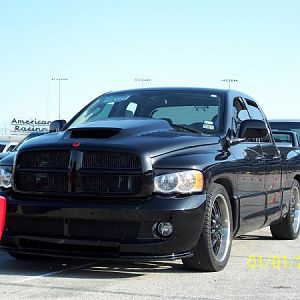
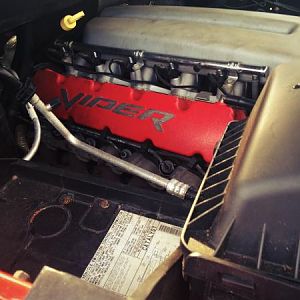
WTF

This carnage looked brutal, but in the long run its probably worth the engine being out to help us all with what might be in our future. Does anyone know if this is an outcome expected to happen or is there a mileage range to think this might happen at ?
What I see is, the extra weight of the truck means the pistons are more stressed. They maybe ok in a standard Viper without any mods but because this is obviously not the first failed engine in my truck, I would change pistons on any engine in a truck even with very little mods. They are a ticking time bomb and self destruct at any time, even as a daily driver. After a lot of research, there is a dramatic shortage of blocks available. Tells the story. The thin ring land is the biggest problem. There are heads, cranks etc. The brand new short blocks are no good because you will have to strip them out and replace the weak pistons. I looked at pictures of these pistons then Gen 4 pistons. Same thin ring lands, I would not buy one of them either. Gen 4 pistons and rods are same as the Hemi engines.....I would keep away from them too. I looked at the forged DSS pistons. The ring land looks 3 times as thick. As for mileage. My truck has done 79000 and this is the second engine I believe has done this. I had on 05 engine in a truck that was built in 03
 
It's disappointing these engines were made so weak, regardless i'm still in for the long haul. I plan on taking mine off the road next year and doing the internals first. I've seen more and more 6spd swaps being done also.
 
It's disappointing these engines were made so weak, regardless i'm still in for the long haul. I plan on taking mine off the road next year and doing the internals first. I've seen more and more 6spd swaps being done also.
Just drive lightly until then. Just put forged internals and they are fine.
I really like the ZF 8 speed trans conversion. If I had the money I would do that. Be just like a Track Hawk. Fast and better on gas
 
This carnage looked brutal, but in the long run its probably worth the engine being out to help us all with what might be in our future. Does anyone know if this is an outcome expected to happen or is there a mileage range to think this might happen at ?
Good question. As Kiwi said probably a good idea to take it easy - Just in case!

If it happened to mine that would be her end! ...... So I better not drive her much hahahaha
 
It's disappointing these engines were made so weak, regardless i'm still in for the long haul. I plan on taking mine off the road next year and doing the internals first. I've seen more and more 6spd swaps being done also.
good outlook and plan
 
This carnage looked brutal, but in the long run it’s probably worth the engine being out to help us all with what might be in our future. Does anyone know if this is an outcome expected to happen or is there a mileage range to think this might happen at ?
Was there an actual cause for this failure that can be determined ? Many trucks have a lot more than 79k miles on them and the motors haven’t done this .. some with mods others stock ! I think it more like the fun factor that causes things like this to happen the majority of the time .. Pilot error , over revving especially with a manual transmission, tunes that lean out the fuel curve , lower quality fuel causing pings and knocks , then there are the bigger power adders like Nitrous , turbos and super chargers that can all knock a hole in a engine using the fun factor ..
 
Last edited:
@Kiwi SRT10 when the engine let loose how were you driving it when it happened ?
How hard was it driven for those 79k miles ? Did you always drive it like you stole it ?
 
good analogies and I tend to agree that those things all factor in to an engine's lifespan...
 
His truck has been driven upside down and backwards it's whole life! Hahahaha!!! A little humor :D
 
Hello SRT-10 Fans.
Just a few Sunday morning thoughts on a Monday…

The pistons on the SRT-10 aren’t great and are indeed mechanically stressed more when accelerating at w.o.t. in a heavier vehicle like a truck and even more stressed with sticky rear drag tires during a 1/8th or ¼ mile pass.

The O.E.M. Piston Ring-Lands have their design to pass emissions. Low rings/ring-lands “hide” unburned hydrocarbons and fail the sniff-test so they aren’t designed that way on emission engines. If any engine doesn’t pass emissions (VW diesel excluded, well, until they got caught), they can’t be mass-produced and sold. BUT higher ring-lands can be more prone to failure.

THE NUMBER ONE KILLER OF ANY PISTON IN A GASOLINE ENGINE IS DETONATION. Even a mildly aggressive tune will crack a ring-land in a stock 8.3L as they are arguably a bit more prone to this type of failure than other performance engines running around. This is no doubt why they are victims of the blanket statement “The pistons are weak”. Keep in mind detonation isn’t just from a tune with too much advance (ignition timing) but it is a big contributor. Low octane fuel has the same effect.

If exposed to even brief detonation, a piston crack MAY hang on for several miles or it may fail immediately.

A number of years ago I believed a buddy could properly tune my 8.3 and the engine almost made it to the 1000- foot mark before it failed on the very first ¼ mile pass after the tune was installed. #8 popped but didn’t jam in the cylinder and take the block out. So, after the tune was installed, my engine lasted less than ¼ mile.

And here is where the “at what mileage will these engines fail?” question comes in. The short answer is immediately with a bad tune but will last a normal duration with decent maintenance and a proper tune (or no tune).

QCs are horribly lame without a PROPER tune and (to me) was worth “rolling the dice”. A 15.2 second E.T. (at our altitude, untuned) just wasn't nearly good enough. I was an early adopter of cross-shipping a brand new ECU to Dan Craigin and Chris Jensen at DC Performance when my truck was new in exchange for another new one with a tune. This was prior to using hand-held OBD II Controllers to get performance tunes in and out. Both Dan and Chris have plenty of experience with Viper engines and do/did R&D for other companies for products installed on Viper engines. These guys know their craft.

Keep in mind that preignition/detonation will also (literally) hammer a forged piston into submission as the ring-lands will often compress and prevent the rings from doing their job. They don’t crack and fly apart like a cast piston might, but eventually the engine will have to be pulled apart if the detonation (whatever is causing it), is left unchecked.


Even a “Forged” engine isn’t indestructible.

Enjoy your trucks and IF something goes south, make a decision then.

 
Last edited:
Hello SRT-10 Fans.
Just a few Sunday morning thoughts on a Monday…

The pistons on the SRT-10 aren’t great and are indeed mechanically stressed more when accelerating at w.o.t. in a heavier vehicle like a truck and even more stressed with sticky rear drag tires during a 1/8th or ¼ mile pass.

The O.E.M. Piston Ring-Lands have their design to pass emissions. Low rings/ring-lands “hide” unburned hydrocarbons and fail the sniff-test so they aren’t designed that way on emission engines. If any engine doesn’t pass emissions (VW diesel excluded, well, until they got caught), they can’t be mass-produced and sold. BUT higher ring-lands can be more prone to failure.

THE NUMBER ONE KILLER OF ANY PISTON IN A GASOLINE ENGINE IS DETONATION. Even a mildly aggressive tune will crack a ring-land in a stock 8.3L as they are arguably a bit more prone to this type of failure than other performance engines running around. This is no doubt why they are victims of the blanket statement “The pistons are weak”. Keep in mind detonation isn’t just from a tune with too much advance (ignition timing) but it is a big contributor. Low octane fuel has the same effect.

If exposed to even brief detonation, a piston crack MAY hang on for several miles or it may fail immediately.

A number of years ago I believed a buddy could properly tune my 8.3 and the engine almost made it to the 1000- foot mark before it failed on the very first ¼ mile pass after the tune was installed. #8 popped but didn’t jam in the cylinder and take the block out. So, after the tune was installed, my engine lasted less than ¼ mile.

And here is where the “at what mileage will these engines fail?” question comes in. The short answer is immediately with a bad tune but will last a normal duration with decent maintenance and a proper tune (or no tune).

QCs are horribly lame without a PROPER tune and (to me) was worth “rolling the dice”. A 15.2 second E.T. (at our altitude, untuned) just wasn't nearly good enough. I was an early adopter of cross-shipping a brand new ECU to Dan Craigin and Chris Jensen at DC Performance when my truck was new in exchange for another new one with a tune. This was prior to using hand-held OBD II Controllers to get performance tunes in and out. Both Dan and Chris have plenty of experience with Viper engines and do/did R&D for other companies for products installed on Viper engines. These guys know their craft.

Keep in mind that preignition/detonation will also (literally) hammer a forged piston into submission as the ring-lands will often compress and prevent the rings from doing their job. They don’t crack and fly apart like a cast piston might, but eventually the engine will have to be pulled apart if the detonation (whatever is causing it), is left unchecked.


Even a “Forged” engine isn’t indestructible.

Enjoy your trucks and IF something goes south, make a decision then.

What are the signs of detonation? Used to look like rats had a nibble, or a stray bit of shot peening etc. Piston and head colours are good and no marks on anything
 
Broken ring lands.
The plug in the cylinder that failed may have fractured porcelain BUT that could have been from shrapnel flying around in your case.
The piston may also have some pitting that tends to sparkle under direct light; but that depends on how long and how severe detonation was.
Melted electrodes on plugs
Hammered out looking rod bearings from severe pressure spikes. These detonation spikes are literally sledge-hammer forces on a piston top.
The Gen III gaskets are quite good, but blown head gaskets are another sign (however not as common).
Normally you can hear preignition first (a light pinging sound under "grunt" throttle conditions) (i.e. lugging the engine) which can be followed by detonation (louder). NOTE: Not everyone can hear pinging as it unfortunately occurs in a frequency range of normal hearing loss.

If you aren't seeing any of this, it may have simply been a rod letting go, which is rare (and unfortunate!)
 
Last edited:
Broken ring lands.
The plug in the cylinder that failed may have fractured porcelain BUT that could have been from shrapnel flying around in your case.
The piston may also have some pitting that tends to sparkle under direct light; but that depends on how long and how severe detonation was.
Melted electrodes on plugs
Hammered out looking rod bearings from severe pressure spikes. These detonation spikes are literally sledge-hammer forces on a piston top.
The Gen III gaskets are quite good, but blown head gaskets are another sign (however not as common).
Normally you can hear preignition first (a light pinging sound under "grunt" throttle conditions) (i.e. lugging the engine) which can be followed by detonation (louder). NOTE: Not everyone can hear pinging as it unfortunately occurs in a frequency range of normal hearing loss.

If you aren't seeing any of this, it may have simply been a rod letting go, which is rare (and unfortunate!)
I had old cars many years ago and knew that pinging noise. That is how we tuned our old 6 cylinder Vauxhalls. Top gear at 30mph WOT and if it pinged we would just trim it abit.
Never heard anything like it on this. The guys at HBR in Christchurch had it on their dyno and had no pinging there.
 
I had old cars many years ago and knew that pinging noise. That is how we tuned our old 6 cylinder Vauxhalls. Top gear at 30mph WOT and if it pinged we would just trim it abit.
Never heard anything like it on this. The guys at HBR in Christchurch had it on their dyno and had no pinging there.
Yes light ping under grunt conditions was essential for tuning certain engines. The majority of Mopar engines responded well to this. The original 426 Hemi picked up around 100 horsepower with enough advance.
Many big block Fords didn’t like the additional advance. Certain Chevs worked well doing this too. I didn't know about the Vauxhalls.
I DO miss being able to tune this way.
 
Yes light ping under grunt conditions was essential for tuning certain engines. The majority of Mopar engines responded well to this. The original 426 Hemi picked up around 100 horsepower with enough advance.
Many big block Fords didn’t like the additional advance. Certain Chevs worked well doing this too. I didn't know about the Vauxhalls.
I DO miss being able to tune this way.
Those were the days .. Computers suck IMO !
 

Latest posts

Support Us

Become A Supporting Member Today!

Click Here For Details

Back
Top